LLM Gateway Architecture Fundamentals
Multi-model production requires centralized control to prevent runaway spend and shadow AI.
Production AI teams no longer run one model. OpenAI, Anthropic, Google, Mistral, Groq, Cohere: new providers and price points arrive constantly, and engineering teams adopt them opportunistically, sometimes without telling anyone. A 2025 Andreessen Horowitz survey of 100 enterprise CIOs found that 37% of enterprises now run five or more models in production, up from 29% the prior year. That number will keep climbing, and not because anyone planned for it.
Without a gateway, every new provider integration means a new API key to manage, new SDK or HTTP client code, new error-handling logic, and a new logging path. The surface area multiplies with every addition. No individual team ever sees the full picture, and nobody is really responsible for the whole.
The failure mode that emerges has a name: shadow AI. Teams integrate models outside IT or security review, leaving no audit trail, no spend visibility, no policy enforcement. A policy memo does not fix this. Structure does. When something breaks in production, figuring out which provider returned the bad response, which team's key blew its budget, or whether a fallback triggered at all requires cross-referencing disconnected logs across teams who don't know each other's workflows exist.
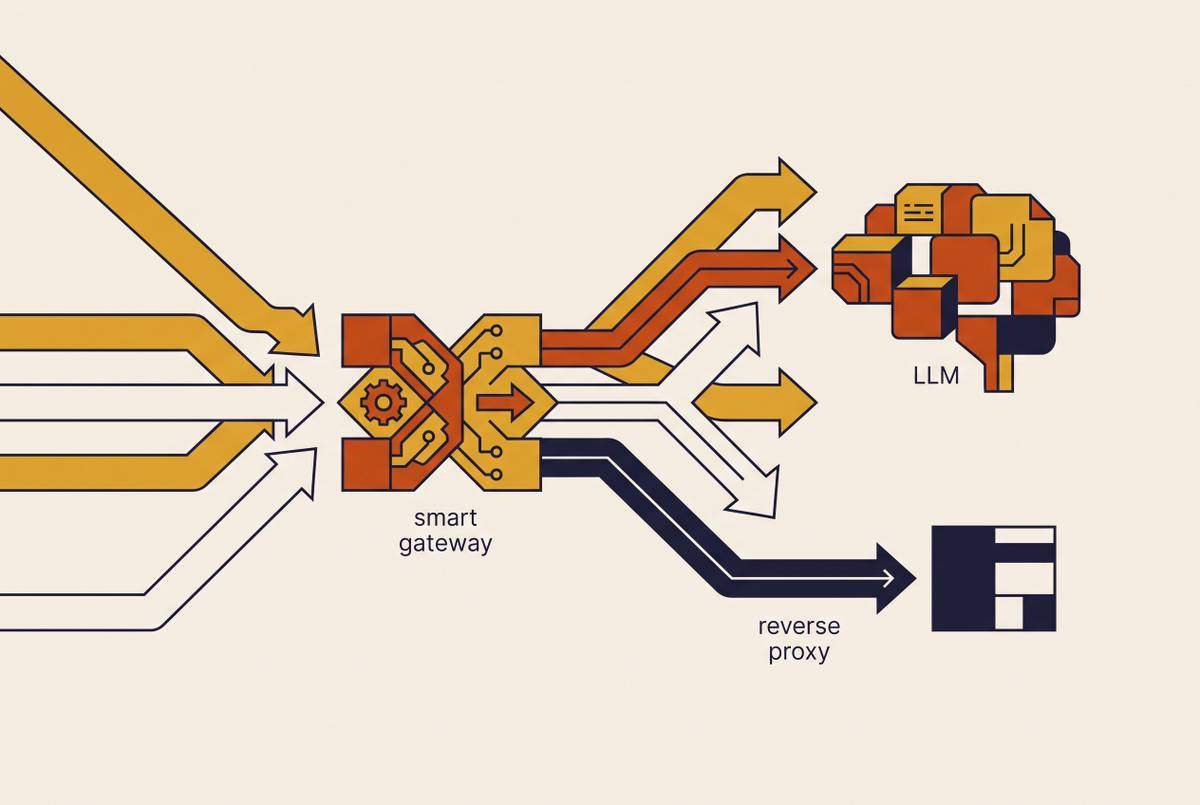
A gateway is not a wrapper library. It is not a prompt template manager or a fine-tuning platform. A wrapper lives inside one application. A gateway sits above all of them, intercepting every outbound request, applying policy, and forwarding traffic to the appropriate endpoint. Routing, spend enforcement, fallbacks, compliance logging: these concerns are cross-cutting. They apply to every request regardless of which application sends it. Duplicating that logic inside each app is the most expensive way to handle it, and most teams arrive at this conclusion only after they've already paid the price.
The Core Components That Make Up a Production Gateway
A production gateway is best understood as a stack of functional layers, each handling a distinct concern. Collapsing them into one vague concept makes the architecture harder to reason about and easier to underestimate.
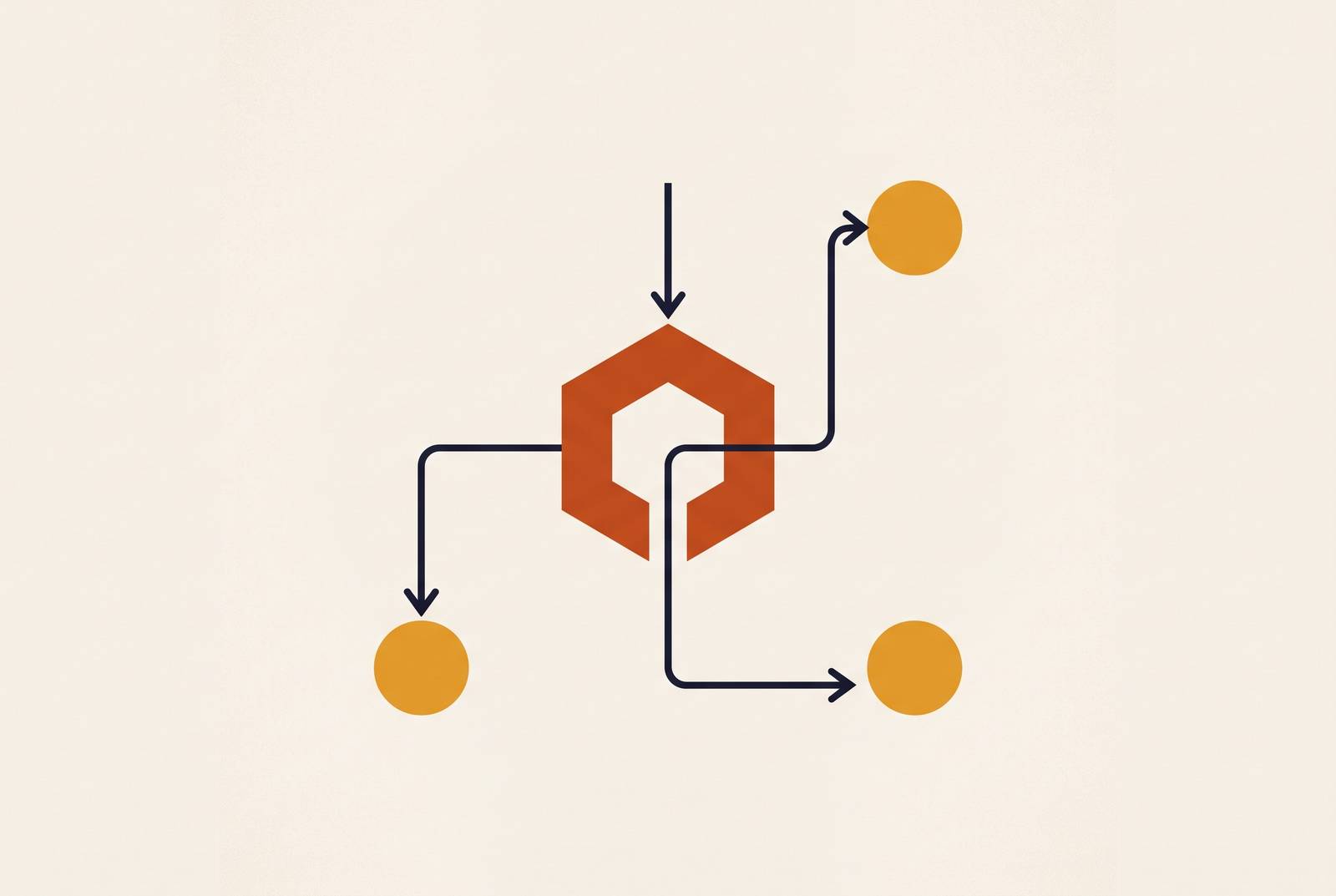
The routing layer inspects each incoming request before a single token is processed, applying criteria like cost ceiling, latency target, task complexity, and provider availability. Pre-request evaluation costs almost nothing compared to inference, which is exactly why it belongs here.
The fallback layer handles automatic failover when a provider errors, times out, or hits a rate limit. Done correctly, application code never sees the outage. The gateway absorbs it and returns a valid response. From the application's perspective, nothing happened.
The spend enforcement layer applies token budgets by team, project, model, or individual API key, blocking or rerouting before excess spend occurs rather than surfacing it after the invoice arrives. That timing distinction is the entire point. Alerts after the fact are not enforcement.
The compliance layer handles PII detection and redaction before requests leave the organization, immutable audit logging of every request and response, and role-based access control over which teams can call which models. This is not enterprise-only territory. Any team handling customer data has the same underlying exposure.
The observability layer tracks latency, error rates, token counts, and cost per request. It has to be native to the gateway, not bolted on afterward. Fragmented traces across separate tools are nearly impossible to correlate when something is actively on fire.
The mechanism tying all of this together is the virtual key. The gateway issues its own keys to applications and maps them to real provider credentials internally. Applications never hold raw provider keys. That mapping is what transforms per-team policy from an aspiration into a structural guarantee.
How Routing Decisions Get Made Across Providers and Models
Every LLM call forces the same tradeoff: cost, latency, and output quality. Optimize for any two and you degrade the third. Hardcoding one model sidesteps the tradeoff entirely and usually means paying frontier prices for tasks that have no business running on frontier models. Plenty of teams do this, especially in the early stages when speed of shipping matters more than cost discipline.
Three routing pattern families address this. Ensemble routing sends parallel queries to multiple models simultaneously, the most robust approach and also the most expensive. Cascade routing tries a cheaper model first and escalates only if the output doesn't meet quality criteria, capturing most of the savings with acceptable latency overhead. Direct routing uses a classifier or policy to select one model per query before inference begins; fastest, but requires the most upfront configuration to get right.
The financial case for routing is not abstract. RouteLLM, published at ICLR 2025 by Berkeley LMSys and Anyscale, demonstrated that a matrix factorization router achieved 95% of GPT-4 quality using only 26% GPT-4 calls, roughly 48% cheaper than a random baseline. With data augmentation applied, the same quality threshold was reached at 14% strong-model calls, a 75% cost reduction. Those results come from MT Bench and MMLU benchmarks routing between GPT-4 and Mixtral 8x7B, so your production numbers will shift based on traffic patterns. The directional finding holds.
The price differential is what makes this worth acting on. GPT-4o output tokens ran approximately $15 per million in 2025 pricing; GPT-4o-mini ran $0.60 per million. A 25-times spread means task-appropriate routing has real financial consequences at any meaningful scale.
Pre-request rules, at-inference cascades, and post-response retries are complementary tools applied at different stages for different reasons. None of them function correctly inside an individual application that lacks real-time visibility into provider pricing, latency, and availability across the full provider set. That visibility only exists at the gateway layer.
What Uncontrolled Token Spend Looks Like at Production Scale
The Uber case makes this concrete in a way that no hypothetical can. Claude Code adoption at Uber jumped from 32% to 84% of a 5,000-engineer organization between December 2024 and March 2025. By April, the entire annual AI budget was gone. Monthly API costs per engineer ran between $500 and $2,000. This wasn't a rogue team or a misconfigured experiment. It was an organization adopting a tool that genuinely worked, at a speed that completely outran the financial controls built to contain it.
FinOps Foundation Executive Director J.R. Storment told TechCrunch that companies were reporting being three times over their entire annual token budget by April. The industry framing shifted from "go fast" to "we need guardrails" in the span of a few months.
The structural reason costs are hard to forecast is that AI inference scales by consumption, not by seat. Two engineers doing nominally similar work can generate wildly different token volumes if one reaches for frontier models by default. Agentic workflows compound this further. A well-configured agent uses five to thirty times more tokens per task than a standard chatbot query. A misconfigured automation running overnight can exhaust a month's budget before the next morning's standup, and nobody will know until the bill arrives.
The unit-cost trend does not rescue teams from this dynamic. Ramp enterprise spending data showed the average cost per million tokens fell from roughly $10 to $2.50 in a single year. The problem isn't unit price. It's unit count growing faster than any forecast built on headcount or seat licenses was designed to anticipate.
By 2025, 98% of FinOps practitioners were responsible for managing AI spend, up from 31% the prior year, per FinOps Foundation data. The function that built its playbook around cloud compute and storage is now managing a consumption model with none of the familiar control surfaces.
How the Gateway Enforces Spend Before It Becomes a Problem
Budget alerts are reactive. Token budgets enforced at the request level are proactive. The gateway blocks or reroutes a request before it executes, not after the billing cycle closes and someone has to explain an overrun.
Granularity is what determines whether enforcement actually creates accountability. A ceiling applied only at the organizational level stops catastrophic overruns but tells you nothing about where consumption is coming from. The useful enforcement hierarchy runs from organization down through team, project, environment, model, individual API key, and agent workflow. Each level prevents any single team from quietly consuming the whole allocation while everyone else operates under the assumption that headroom still exists.
Virtual keys are the mechanism that makes this structurally enforceable. Each team or application gets its own key with its own budget ceiling baked into the gateway's policy configuration. The gateway enforces the ceiling before forwarding to any provider. Enforcement is not contingent on the team remembering to check a dashboard.
Semantic caching works alongside budget enforcement as a complementary lever. The gateway detects meaning-level similarity across requests and returns cached responses where appropriate, reducing token usage, latency, and provider cost without requiring any change in application behavior. Support workflows, policy Q&A, and documentation assistants are where this pays off most clearly, because many incoming questions are semantically close to questions already answered.
What makes any of this actionable is attribution. Without token-level data tied to specific users, teams, and projects, engineering leaders cannot distinguish high-value AI usage from runaway consumption. A 200-person organization where a handful of developers each generate several thousand dollars a month in token costs can represent a substantial monthly bill sourced from under ten percent of the team. That pattern is invisible until it is already a problem, and by then the conversation is about damage control rather than prevention.
How the Gateway Handles Data Security and Compliance Requirements
Every request that leaves an application and reaches a model provider potentially carries sensitive data. PII, PCI, PHI: customer names, payment details, health information embedded in prompts, sometimes intentionally and sometimes because a developer didn't fully trace what data was flowing into a template. Both scenarios happen more often than teams expect, including teams that think they have this covered.
PII redaction at the gateway layer detects and scrubs sensitive fields before the request is forwarded to any provider. The original data never leaves the organization's perimeter. Redaction also needs to be reviewable and auditable, not a black box. If you can't inspect what the redaction layer is doing, regulated industries won't accept it.
Audit logging creates an immutable record of every request and response: which model was called, which key was used, what the request contained. Reconstructing what happened from application logs scattered across teams is not a viable investigation strategy after a production incident. It's slow, incomplete, and depends on individuals who are no longer at the company.
Role-based access control determines which teams or applications are permitted to call which models or providers, preventing a developer key from accidentally routing a request to a model that hasn't been approved for the data classification of a given workflow. These mistakes happen without access control. They are rarely caught quickly.
Zero data retention arrangements with providers add another layer. Some provider endpoints do not log or train on request data, and the gateway is where you enforce which traffic routes to those endpoints. That enforcement doesn't work if applications are connecting to providers directly.
The organizational argument for handling compliance at the gateway layer is the same one that applies to spend enforcement. Compliance requirements aren't enterprise extras retrofitted after scale. A team of any size handling customer data has the same underlying exposure. Centralizing these controls means they don't have to be rebuilt by every application team independently, which is how you end up with fifteen inconsistent implementations of something that should be uniform across the entire organization.
Reliability and Fallback Behavior in Production
Provider outages are not hypothetical. Every major provider has had availability incidents. An application without fallback logic is fully exposed to whatever SLA the provider delivers, which is a meaningful operational risk for anything customer-facing.
Fallback at the gateway layer means that when a provider errors, times out, or rate-limits, the gateway reroutes to the next configured provider. The application receives a valid response and never sees the failure.
Fallback chains require deliberate configuration. Which provider to try first, which to fall back to, and in what order: these are routing policy decisions, not error-handling decisions. They belong in infrastructure configuration, not scattered across application try/catch blocks. The latter approach means each team is independently maintaining policy that should be consistent across all teams, and those independent implementations will drift.
Amazon SageMaker's published benchmarks offer a concrete data point. Switching to least-outstanding-requests routing improved P99 latency by between 4 and 33% over random routing at production scale. Directing traffic away from loaded or slow endpoints is a reliability strategy, not merely a performance optimization.
Fallbacks only work reliably if the gateway is measuring provider health in real time. A gateway that cannot see latency and error rates across its configured providers cannot make intelligent failover decisions. This is another reason observability must be native to the gateway architecture.
What This Architecture Means for Teams Deciding How to Implement It
Two implementation paths exist: self-hosting an open-source gateway, or using a managed gateway-as-a-service where the provider operates the infrastructure.
Self-hosting gives teams full control and transfers full operational responsibility. Deployment, scaling, patching, incident response, and the ongoing cost of maintaining infrastructure that is not your product. The real cost of building isn't the initial setup; it's the maintenance load as provider APIs change, new models are added, and security requirements evolve. Teams almost always underestimate this when doing the initial comparison, because the initial setup feels tractable and the long-term maintenance cost doesn't show up until you're already committed.
The managed path removes the operational burden and introduces a different dependency: the provider's reliability and roadmap. That is a genuine tradeoff, worth naming clearly rather than glossing over.
The decision criteria that actually matter: how many providers the team needs to route across, whether compliance requirements like PII redaction, audit logging, and zero data retention are active needs or anticipated future ones, how much engineering capacity is available for non-product infrastructure, and whether spend visibility is needed by stakeholders outside engineering, specifically finance and security. If the answer to that last question is yes, the case for a managed solution with purpose-built reporting becomes considerably stronger.
Gartner projects that by 2028, 70% of software engineering teams building multimodel applications will use AI gateways, up from roughly 25% in 2025. Most teams won't implement a gateway because they read a projection. They'll implement one after an incident, a surprise invoice, or a compliance question they couldn't answer.