Credential Management in Multi-Provider LLM Stacks
Managing credentials across multiple LLM providers requires abstraction, not just secrets storage.

No single model wins on cost, speed, and quality simultaneously. That is the actual driver behind multi-provider sprawl, and it is worth naming plainly because most post-mortems skip it. Teams adopt a cheaper model for high-volume, simple queries; a faster one for latency-sensitive user-facing features; a more capable one for reasoning-heavy tasks. Each individual decision is defensible in the meeting where it gets made. The aggregate consequence is what nobody plans for.
Every provider added brings its own API key, its own authentication scheme, its own rotation policy, its own revocation flow. Keys end up in application code, environment variables, CI/CD pipelines, individual developer dotfiles. They get duplicated across development, staging, and production without anyone making a deliberate choice to do it that way. It just happens, incrementally, until one day someone asks how many live keys exist across all providers, which systems are using them, and when they were last rotated. The answer, at most organizations running more than two or three providers, is that nobody actually knows. The information is scattered across provider dashboards, code repositories, and vault entries that stopped reflecting current state months ago.
The access control situation compounds this. Provider-issued keys are blunt instruments. There is no native mechanism to restrict a key to a specific team or project, or to enforce a spend ceiling, without building that logic yourself. Rotating a single provider's key means finding every reference to it across the codebase, updating each one, redeploying, verifying. Do that across five providers and it becomes a recurring operational tax nobody wants to pay, so teams defer it. Sometimes indefinitely. The latent risk in that deferral is straightforward: a key leaked through a repository or a log file grants an attacker full, unscoped access to that provider's API, with no audit trail tied to internal identity, no rate limiting per team, no alerting. Just open access, for as long as the key remains live.
How the Security Risk Compounds as the Provider Count Grows
Multi-provider exposure does not add linearly. Each additional provider key represents an independent blast radius, and the gaps between providers are where the real risk concentrates. A compromise at one does not automatically invalidate the others, but because rotation is manual and operationally painful, teams delay. Keys stay live longer than they should. The exposure window is not a function of malice; it is a function of friction.
Data retention adds a dimension that often goes unconsidered until a compliance review forces the question. Some providers retain API data by default for abuse monitoring. Zero-data-retention typically requires a negotiated enterprise agreement, which most teams on standard plans do not have. So beyond the key itself, the data flowing through it carries its own handling implications, and those compound separately from the key management problem.
The regulatory environment reflects this reality directly. GDPR, HIPAA, and PCI-DSS require auditable, runtime controls over AI data flows. OWASP elevated Sensitive Information Disclosure to a top-tier concern in its 2025 LLM Top Ten, specifically noting that LLMs require broader organizational data access to function well, which widens the exposure surface considerably. An uncontrolled key used to send personally identifiable information to a provider is not merely a security incident; it is a compliance event. The European Data Protection Board's publicly reported enforcement statistics show cumulative GDPR fines exceeding €5.88 billion between May 2018 and the end of 2024. That number represents what regulators actually do with this category of failure, not what they theoretically do.
Two providers means two independent exposure surfaces. Five providers means rotation schedules that drift out of sync, logs that share no common structure, and multiple distinct pivot points for an attacker to exploit. Think of it like leaving five different doors unlocked in the same building: each one is its own way in, and checking that you locked one tells you nothing about the other four. The interesting risk is not inside any single provider's controls. It lives in the spaces between them.
Why Application-Level Credential Management Cannot Scale Past a Certain Point
The common stopgap is storing keys in a secrets manager, injecting them at runtime through environment variables, rotating on a schedule. This works reasonably well for one or two providers. It starts fraying around three. By five, every strand of credential management looks like it belongs until you try to pull one out, and three other things move with it.
The structural problem is that application code still has to know which key maps to which provider. Every new model integration means touching authentication logic, updating injection points, re-testing across environments. That is engineering time spent on credential plumbing rather than on the feature that motivated the new model integration. It is invisible overhead that accumulates on the roadmap until someone looks up and notices how much time has disappeared into it over the past two quarters.
There is also no unified identity layer. The application owns its own keys, so there is no coherent concept of a team, a project, or a cost center that spans providers. If a team member departs or a project is deprecated, revoking access requires a manual sweep across every provider the application touches. There is no single action that cuts access off cleanly. This is the kind of thing that feels manageable at two providers and genuinely is not at five.
Secrets managers solve storage and rotation for individual credentials. What they do not solve: normalizing access patterns across providers, enforcing per-team scoping, or producing a cross-provider audit log of which identity called which model at what time and what cost. They were designed for a different problem. Trying to use them as the primary governance layer for a multi-provider LLM stack is like using a good filing cabinet to run a library. Technically functional; wrong tool for the job.
What is actually needed is a layer that sits between the application and the providers, owns the real credentials, and exposes only a controlled, scoped interface downstream. That is not a secrets manager. That is a gateway.
The Gateway as a Credential Abstraction Layer
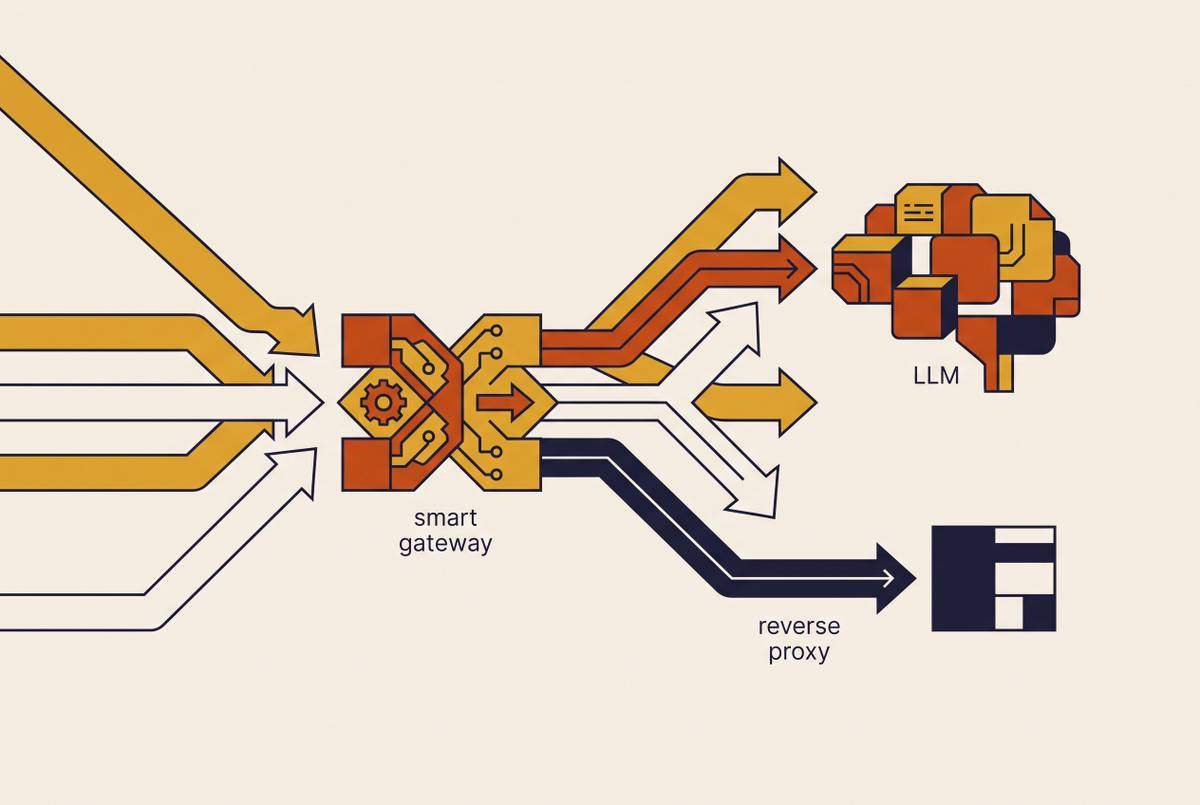
The pattern is not complicated. The gateway holds all real provider API keys in one place. Application code holds only a gateway-issued virtual key: a scoped, revocable token that represents an internal identity, whether that is a team, a project, or a specific service. The application never knows which underlying provider credential is actually being used. It sends a request to the gateway, the gateway authenticates the virtual key, applies policy, and forwards the request with the appropriate provider credential attached.
Virtual keys can be scoped in ways that provider-issued keys simply cannot. Restrict a key to specific models, specific providers, a defined spend ceiling, a particular time window. These are controls the application would otherwise have to build and maintain itself, somewhere in the codebase, by someone who will eventually leave the team. In the gateway, they are policy. They live in one place and apply consistently.
Revocation is where this architecture pays off most visibly. Revoking a virtual key cuts off access across every provider the gateway manages. No per-provider rotation cycle, no search through application code for references, no redeployment window. One action, complete effect. Anyone who has spent an afternoon tracking down all the places a compromised key was used will understand immediately why that matters.
The gateway also normalizes the API surface. One authentication scheme, one request format, one error model. Adding a new provider does not require new authentication logic in the application. The integration work happens once at the gateway level, and every downstream application inherits it automatically.
This is not a novel idea. It is the same architecture that resolved credential sprawl in traditional API management years ago: a reverse proxy that owns upstream credentials and issues downstream tokens to consuming applications. The LLM ecosystem is arriving at the same solution, for the same reasons, just a few years into a different infrastructure cycle.
What Centralized Credential Control Enables Beyond Security
Security is the most urgent argument for this architecture. It is not the only one, and in practice the other benefits are what often get engineering leaders to move on it.
Spend attribution becomes tractable for the first time. Because every request carries a virtual key tied to an internal identity, cost can be broken down by team, project, feature, or individual service. When applications call providers directly with shared keys, that signal does not exist. Finance asks which team is responsible for the $40,000 overage, and the honest answer is that nobody can tell. The gateway creates the signal that makes that question answerable.
Access governance follows directly. Role-based access control at the virtual-key level means a new team member receives a scoped key with defined limits, not a copy of the master credential. Onboarding becomes a policy operation. Offboarding is a single revocation, not a credential hunt across provider dashboards and deployment configurations that depends on whoever set the original integration still being around to explain it.
Audit log completeness is another direct consequence. The gateway produces a unified record of every model call: model, provider, virtual key identity, token count, latency, cost, across all providers, in one place. That log answers the questions auditors ask without requiring someone to manually aggregate output from multiple provider dashboards the week before a compliance deadline. Anyone who has done that aggregation manually knows the specific misery of it.
Failover and routing also benefit in ways that matter under pressure. When a provider goes down, the gateway routes to a fallback. The application credential does not change. The failover logic lives in gateway policy, not in application code that would require redeployment at the worst possible moment. This is the kind of resilience that looks unnecessary until the night it is not.
What to Look for When Evaluating a Gateway's Credential Handling
Not all gateways handle credentials with equal rigor. Some of these questions are uncomfortable to ask vendors directly. Ask them anyway.
Virtual key scoping. Can keys be restricted by model, provider, spend limit, and time window? Or are they coarse tokens that grant broad access with no meaningful constraints? The granularity of scoping determines whether the gateway actually resolves the access control problem or merely relocates it one level up.
Rotation and revocation. Can a virtual key be revoked instantly across all providers simultaneously? Is there a rotation flow for the underlying provider credentials that does not require application redeployment? Rotation that requires touching application code is not meaningfully better than the problem it is supposed to solve.
Audit log granularity. Does every request carry a virtual key identity in the log, enabling per-team and per-project attribution? A log without identity is a log you cannot act on, regardless of how complete it looks. This is worth pressing on specifically, because vendors will describe log completeness in ways that sound reassuring until you ask whether internal identity is actually recorded per request.
Secrets handling. Where are the real provider credentials stored? In the gateway vendor's managed infrastructure, in your own vault, or in configuration files sitting on disk somewhere? Demand a specific answer. Vagueness here is informative on its own.
Zero-data-retention support. Does the gateway enforce that requests carrying sensitive data are routed under ZDR agreements with providers? Does it prevent those requests from being logged at the provider level? For teams handling regulated data, this is a hard requirement, not a nice-to-have.
Operational model. A self-hosted gateway keeps credentials on your own infrastructure, which satisfies certain compliance postures and keeps the credential surface internal. The tradeoff is that your engineering team owns the operational burden of securing, rotating, and maintaining the gateway itself. A managed gateway moves that surface to the vendor, which requires genuine trust in their security practices and incident response capabilities. Neither option is universally correct. The right choice depends on team capacity and compliance requirements, not on which option the vendor leads with in the demo.
Building credential management correctly, with scoped virtual keys, unified audit logs, cross-provider revocation, and secure secrets storage, is substantial infrastructure work. It does not ship product features. For most engineering leaders running several providers in production, the real question is whether that work belongs on their roadmap at all, or whether it is already solved infrastructure that can simply be adopted. The answer, for most teams, is obvious once they have spent a few months doing it themselves.