LLM Gateway vs Reverse Proxy for AI Traffic
An LLM gateway reads what's inside requests; a reverse proxy just forwards them blindly.
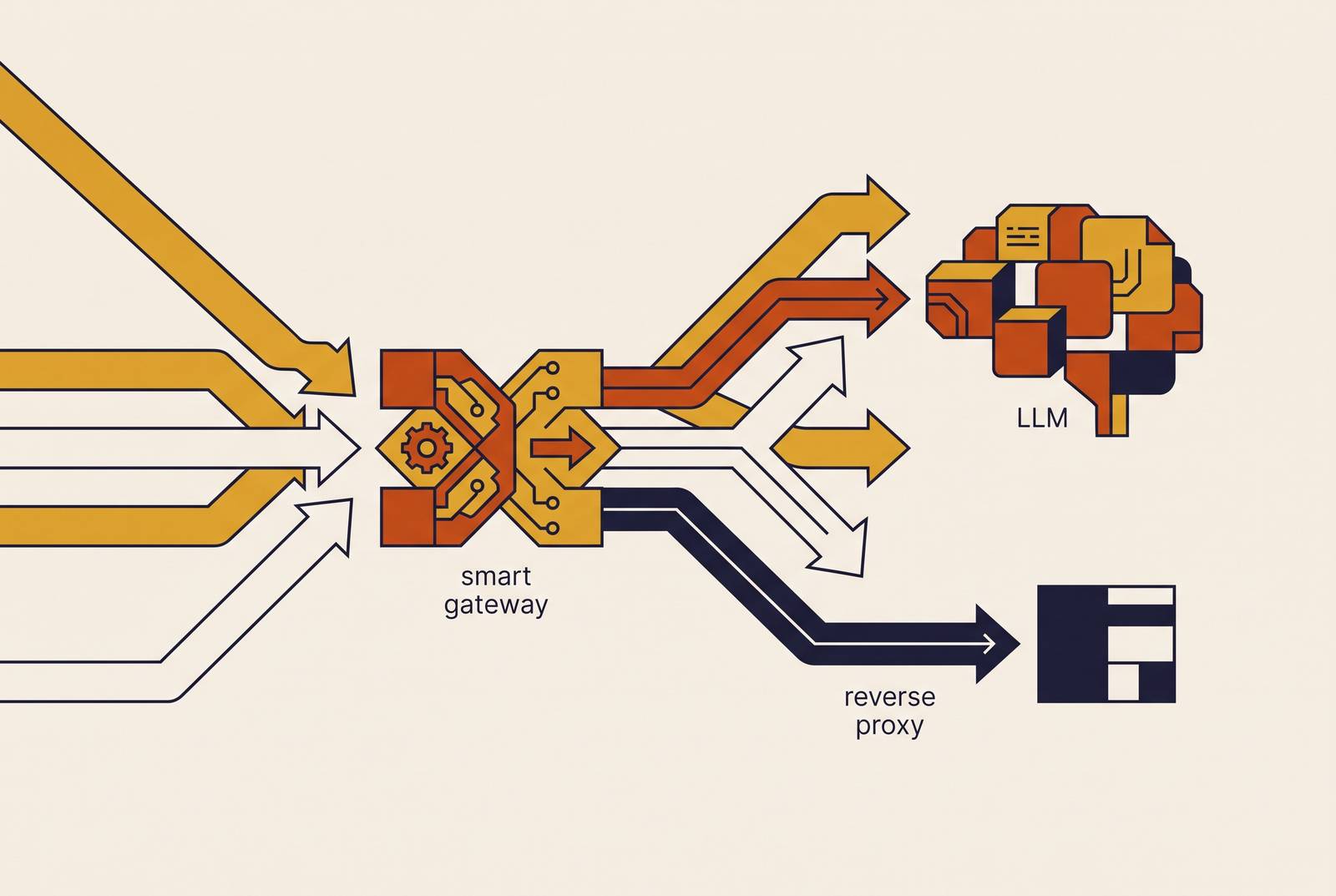
A reverse proxy does its job well. It terminates TLS, forwards requests, load balances across backends, injects auth headers, rate limits by IP or endpoint, and caches responses. All of that happens at the transport layer. The proxy doesn't care what's inside the request, and that indifference is by design. For most traffic, it's exactly right.
The indifference holds up when your backends are interchangeable: identical response shapes, stateless connections, predictable payload sizes. The proxy treats all traffic as equivalent because, in most cases, it is.
LLM traffic breaks every one of those assumptions simultaneously. Payload size varies by orders of magnitude depending on whether you're sending a one-line prompt or a 100,000-token document. Response format differs across providers. Streaming responses require persistent connections that a standard reverse proxy handles awkwardly. The cost of a single request can swing from fractions of a cent to fifty cents depending on the model and token count. None of that is visible to the proxy. It registers a request, forwards it, registers a response. What passed through the wire is not its concern.
You can absolutely sit a reverse proxy in front of OpenAI. It just cannot do anything meaningful with what passes through it. No concept of tokens, no awareness of provider identity, no mechanism to normalize response formats, no abstraction that maps to how LLMs actually work. This isn't a criticism of the tool. It's a precise description of where the tool stops, and that boundary matters more than most teams realize until they've already crossed it.
The three structural failure modes that emerge when teams route AI traffic through a general-purpose proxy
The infrastructure most engineering teams built for AI traffic was designed before the problem existed in its current form. Two years ago, AI deployment meant one model, one API key, one SDK. Today it means multiple providers with incompatible auth models, prompt-heavy applications, and agentic systems running multi-step tasks across workflows nobody fully mapped in advance. The instinct to route that traffic through a reverse proxy is understandable. Teams already have them, they work, and HTTP traffic is HTTP traffic.
Except it isn't.
The proxy doesn't cause what follows directly. It simply provides no surface to prevent anything, so problems compound silently until they become a budget crisis or a compliance incident.
The first failure mode is security. When a reverse proxy is the only intermediary, application code holds provider credentials, and every service that calls a model is a potential credential leak. There is no central inspection point. Prompts and responses cross the network unexamined. Cyberhaven's 2026 report found that nearly 40% of enterprise AI interactions involve sensitive data, and all of it flows through those unexamined connections.
The second is cost unpredictability. A shared API key carries no identity, no budget, no enforcement mechanism. Every team calling the same credential produces one undifferentiated invoice line. The cost surfaces days later in a billing dashboard and cannot be attributed to a team, an application, an agent, or a specific use case. That's an architectural problem, not a reporting one, and the distinction matters because reporting problems are solvable with better dashboards.
The third is operational fragility. Adding a second provider without purpose-built infrastructure means duplicating auth handling, rewriting rate-limit logic, updating every service that calls a model, and trusting that the governance decisions made in the first integration get replicated consistently in the second. They don't. Governance bolted on per integration stays consistent in documentation, and then it drifts.
What an LLM gateway adds that a reverse proxy cannot: the model-aware layer
An LLM gateway is, architecturally, a reverse proxy for model APIs. Applications send requests to a single endpoint, typically OpenAI-compatible, and the gateway handles provider selection, authentication, and policy enforcement transparently. The application doesn't need to know which provider it's talking to.
That's the surface description. What's actually different is this: a general-purpose proxy knows that a request exists. An LLM gateway knows what's inside it. The prompt, the token count, the model identity, the response structure, the streaming state. That distinction is everything. Token accounting becomes possible only when the infrastructure can count tokens. Prompt normalization across providers becomes possible only when the infrastructure can read prompts. Policy-based model selection, semantic fallback, per-model telemetry at the level of latency percentiles and cost per thousand tokens: all of it depends on the gateway understanding the payload rather than forwarding it.
What this means operationally is that provider complexity moves out of application code and into the infrastructure layer, where it gets managed uniformly instead of re-solved in every integration. Switching from GPT-4o to Claude to a Mistral-hosted model without changing a line of application code becomes possible because the gateway absorbs the SDK and format differences. That's not architectural elegance for its own sake. It's the difference between a governance posture you can actually enforce and one that lives in a wiki nobody reads after the first quarter.
Gartner projects that 70% of software engineering teams building multimodel applications will use AI gateways by 2028, up from roughly 25% in 2025. That trajectory reflects a market that has already worked through the proxy assumption and found it insufficient. The teams that got there first mostly did so the hard way.
How intelligent routing handles the cost-quality tradeoff a proxy ignores entirely
Every LLM call forces a tradeoff between cost, latency, and quality. Optimize for any two and you degrade the third. A reverse proxy cannot participate in this tradeoff at all; it forwards the request wherever you've told it to forward requests, with no knowledge of what the request costs or what quality threshold it requires.
The pricing spread makes this consequential. The cheapest production models run around $0.04 per million tokens. Frontier reasoning models run upward of $180 per million. That is a roughly 4,500x range across a single dimension of the market. Routing strategy across that range isn't an optimization exercise. It's a financial decision made on every request, whether or not anyone has acknowledged it as such.
Research presented at ICLR 2025 demonstrated that a matrix-factorization router achieved 95% of GPT-4 performance while sending only 14% of queries to the strong model, producing an 85% cost reduction on the MT-Bench benchmark. Those are benchmark numbers, not a production guarantee for every workload. But they illustrate a realistic ceiling for what intelligent routing can recover, and most production systems aren't close to that ceiling yet.
The practical implementation doesn't require that level of sophistication to capture most of the value. Default traffic to a smaller, cheaper model. Escalate when confidence thresholds aren't met or task complexity warrants it. Waterfall-style routing handles the majority of traffic at a fraction of the cost with no visible quality degradation for the end user. You don't need a conference paper to implement this; you need a gateway that can read the request.
One thing worth saying plainly: routing is not only about saving money. A well-designed routing system directs requests to the model best suited for a specific task type, which may outperform a single frontier model on that task. Cost optimization and quality optimization aren't always in tension. Sometimes they point in the same direction, and recognizing that changes how you architect the logic.
The routing strategy ladder moves from static rules to weighted splits, then to latency-aware and cost-aware routing, then to semantic routing and model cascades. Each step requires more model awareness than the last. A reverse proxy can implement weighted splits at the HTTP level. Everything above that requires understanding what's inside the request, and that's the hard boundary.
Token-aware cost controls and why request-path enforcement is the only kind that works
Average monthly enterprise AI spend jumped from roughly $63,000 in 2024 to roughly $85,000 in 2025, while only about a third of companies had mature cost management processes in place during that period. The spend is growing faster than the governance meant to contain it.
The Uber case is instructive. Five thousand engineers were given access to Claude Code in December 2025; by April 2026, the entire annual AI budget was gone. Not overspent incrementally. Exhausted. This happens because a shared API key has no identity, no budget, no limit. Anyone with the key spends from the same undifferentiated pool, and no one sees the cumulative total until the billing cycle closes. Agentic workflows compound the problem further: they consume between five and thirty times more tokens per task than standard chat interactions, per Gartner's 2026 analysis. Teams that budgeted on per-token rates without accounting for agentic multipliers tend to discover the discrepancy at the worst possible time.
Gateway-level enforcement restructures the architecture of the problem. Virtual keys give every consumer an identity: a team, a project, an application, an agent. Hierarchical budgets bound what that identity can spend. Parallel token and request limits contain burst behavior that budget caps alone are too slow to catch, because budget tracking happens asynchronously and a burst can exhaust a budget before the next billing check runs.
A budget cap is a post-hoc alarm. A token limit is a pre-request gate. These are not equivalent controls, and conflating them is how organizations end up in the position Uber found itself in.
Alert thresholds at 50%, 75%, and 90% utilization let teams throttle naturally rather than hitting hard stops during critical business hours. That graduated response is the difference between catching an overrun early and discovering it during a production incident on a Friday afternoon.
A reverse proxy can rate-limit by request count. It cannot allocate spend by team, project, or model. It sees requests, not tokens, and it has no concept of cost. Forrester projects that 60% of enterprises will adopt automated policies restricting generative AI budgets per team or department. That enforcement only exists at a layer that understands what a token is.
PII redaction, provider data retention, and why the inspection point matters
Cyberhaven's 2026 report found that nearly 40% of enterprise AI interactions involve sensitive data, much of it flowing through unmanaged personal accounts that bypass corporate controls entirely. The exposure is routine, not hypothetical.
Provider retention defaults are not what most teams assume. OpenAI retains API data for 30 days for abuse monitoring. Anthropic reduced standard log retention to 7 days in September 2025. Zero-data-retention arrangements require a negotiated enterprise agreement; they are not the default on pay-as-you-go plans. Most teams operating under the assumption that their prompts aren't being retained should verify that assumption against their actual contract tier.
OWASP elevated Sensitive Information Disclosure to the second position in its 2025 LLM Top Ten, noting that LLMs now require broader access to organizational data than previous generations of applications, which dramatically widens the exposure surface. The risk is structural. Telling engineers to be careful does not address it.
Gateway-level PII redaction detects and strips sensitive information from prompts before they leave the organization's network. More importantly, it logs what was redacted, when, and by which rule, making redaction reviewable and auditable rather than a one-time configuration that nobody can verify after deployment. Under GDPR and HIPAA frameworks, that audit trail is not optional.
A reverse proxy can inspect HTTP payloads at the byte level. It has no semantic understanding of what constitutes PII in a natural language prompt, no integration with provider-specific request formats, and no mechanism to log redaction actions in a way that satisfies a compliance audit. For regulated industries, the gateway is the only architectural layer where prompt-level enforcement is possible without rewriting every application that calls a model.
Reliability in production: fallbacks and failover beyond what a load balancer handles
Provider outages are not theoretical. Every major provider has had availability incidents. Without a fallback path, a provider outage is an application outage. For agentic workflows specifically, a mid-task failure doesn't just degrade a response; it breaks the entire agent run, and recovering intermediate state is often harder than starting over.
A reverse proxy load balances across identical backends. LLM providers are not identical. Different APIs, different model capabilities, different token limits, different response formats. You cannot round-robin a request formatted for GPT-4o onto Claude's API without translation, and the proxy has no mechanism to perform that translation.
Gateway-level fallback handles this correctly. If a provider returns a 429 or a 5xx error, the gateway retries on an alternate provider with the prompt already normalized for that provider's format. The application receives a response and never knows a fallback occurred. That requires the gateway to know which models are substitutable for a given request type, what the provider's error semantics mean, and how to reformat the request for the target. None of that reasoning is available to a general-purpose proxy.
Gartner forecasts that 40% of enterprise applications will embed task-specific AI agents by end of 2026, up from less than 5% in 2025. As agentic workflows proliferate, reliability requirements get stricter, not looser, because the cost of a mid-task failure scales with task complexity. The infrastructure needs to match that trajectory, and the infrastructure built for stateless web traffic doesn't.
When a reverse proxy is the right call, and when it isn't
A reverse proxy is appropriate when the team calls a single provider, runs low traffic volume, needs only basic auth header injection, and has no compliance requirements, no cost governance requirements, and no plans to add a second provider. At that scale and scope, a proxy is sufficient and operationally simpler. Avoid adding infrastructure you don't need.
The inflection point arrives the moment any of those conditions changes. Second provider. AI spend that needs justification. Any request carrying PII. At that point, the proxy's limitations stop being acceptable gaps and become active liabilities, the kind that surface in budget reviews and compliance audits rather than engineering retrospectives.
The LLM gateway category has matured to the point where teams are no longer choosing between building something custom and going without. Twelve or more serious options now exist, ranging from open-source libraries to managed enterprise services. Self-hosted gateway software shifts operational burden onto engineering teams: someone has to maintain uptime, manage upgrades, and instrument observability. That cost is real even when the software is free.
The build-versus-buy question is not really about capability. Most teams can wire together the pieces if they spend the time. It's about whether engineering time is better spent on that infrastructure or on the products the infrastructure is supposed to support. Say that out loud to the right stakeholder, and the answer usually becomes obvious.