Provider Concentration Risk in Production AI Systems
Teams are already dependent on single AI providers without realizing the full scope of the risk.

Provider concentration risk in production AI is a structural condition, not a hypothetical one, and most engineering teams are already living inside it without realizing it.
Why production AI systems depend on their providers more than their architecture diagrams suggest
Walk into most codebases running AI in production and the diagram will show one clean box labeled "LLM provider." The code tells a different story. A common pattern is five different OpenAI client instances pointing at five different base URLs, each with its own copy-pasted retry logic that works slightly differently from the one next to it. It's sprawl: the kind of thing that happens when five teams solve the same problem five times, on five different timelines, with no one assigned to the question of what happens when a provider goes down.
The reason this now matters more than it used to is simple. When a core workflow breaks, customers notice, revenue notices, and the fix has to happen in minutes, not sprint cycles.
Multi-Provider Diversification Can Mask a Single Point of Failure
The standard instinct, once a team notices they're dependent on one AI provider, is to sign a contract with a second one. That instinct is reasonable, but on its own it is close to useless because of where the actual infrastructure lives.
OpenAI runs on Azure. Anthropic runs on AWS, GCP, and Azure. Google's own models run on GCP. The diversity is visible on the procurement chart but not in the infrastructure that actually processes the requests.
Vendor-level diversity differs from infrastructure-level diversity, and that distinction is the whole problem in miniature. A standard SOC 2 report or a vendor security questionnaire isn't built to surface it. The risk stays invisible to the exact instruments procurement and security teams rely on to catch this kind of thing.
The three specific failure modes concentration risk produces in production
Concentration risk doesn't produce one kind of damage. It produces three, and they tend to land together, because all three trace back to the same single point of failure.
The first is operational. Systems built on a single AI vendor don't degrade gracefully when that vendor has a problem; they stop. Support bots go quiet, code-review agents stop reviewing, and whatever automation depends on that model sits idle until the vendor comes back or someone builds a replacement under pressure. Before gateways existed, each team managed its own API keys, its own budgets, its own retry logic, its own logging. Visibility was fragmented and governance was inconsistent team to team. That fragmentation makes a coordinated response impossible when the failure actually hits. There was never a single system managing the dependency in the first place, so there's no single lever to pull.
The second is financial, and it appears in the margin line. At AI-native companies, inference costs can account for a large share of revenue, so when a provider changes its pricing and that change passes straight through, it can take real points off gross margin with the product itself unchanged. Nothing about the business got worse. The bill did.
The third is regulatory, and it matters even for teams that don't think of themselves as working in a regulated industry. Moody's has flagged the practice of lenders and insurers consolidating AI onto a small number of model builders and cloud platforms as a systemic risk, and the IMF's analysis went further, warning that a single exploited vulnerability could cascade across many institutions at once given how reliant they've become on a small set of cloud providers, software platforms, and AI models. Under DORA and the EU AI Act, regulated financial entities now have to assess concentration risk directly and govern their ICT vendor compliance programs, which turns this from an engineering concern into something that shows up in due diligence on a transaction. For most engineering teams this is the least pressing of the three. It's still the one that will eventually show up on a board agenda.
What the 2026 Incidents Established
For years, concentration risk in AI was an argument made in the abstract, the kind of thing a security team flags in a slide deck that nobody acts on. In 2026, four separate incidents turned it into something that had already happened.
The first came from Anthropic's Fable 5 and Mythos 5 models, in the middle of the year. The U.S. Commerce Department ordered both models offline under export-control authority, just days after launch. Any organization built entirely around that one model had no fallback while it was gone and no say in what it would cost once it returned.
The second came from the infrastructure layer itself rather than a model vendor. On March 24, 2026, two malicious LiteLLM releases, versions 1.82.7 and 1.82.8, reached PyPI. They harvested credentials from any installation that pulled the package without pinning a version. Deployments running pinned Docker images were untouched. LiteLLM pulled the packages and shipped a hardened release pipeline in version 1.83.0. This incident pointed at a different failure mode entirely: dependency on a single self-managed open-source gateway component, with no version-pinning discipline and no managed patch cycle standing behind it.
Then, in September 2026, came correlated outages across multiple providers at once. That event is the one that validates the larger argument, because it shows the risk isn't limited to any single vendor having a bad day. When the underlying infrastructure that multiple "different" providers share runs into trouble, the trouble doesn't stay contained to one vendor relationship. It moves across all of them at the same time, which the procurement-chart diversity in the earlier section fails to protect against.
Why the Fix Requires a Control Plane
Signing a second vendor contract after any of this feels like progress, and it isn't, not on its own. If nothing sits between application code and the providers to actively manage the relationship, a second contract just means a second independent failure surface. It doesn't create the ability to respond to a failure when one hits; it just doubles the number of places a failure can start.
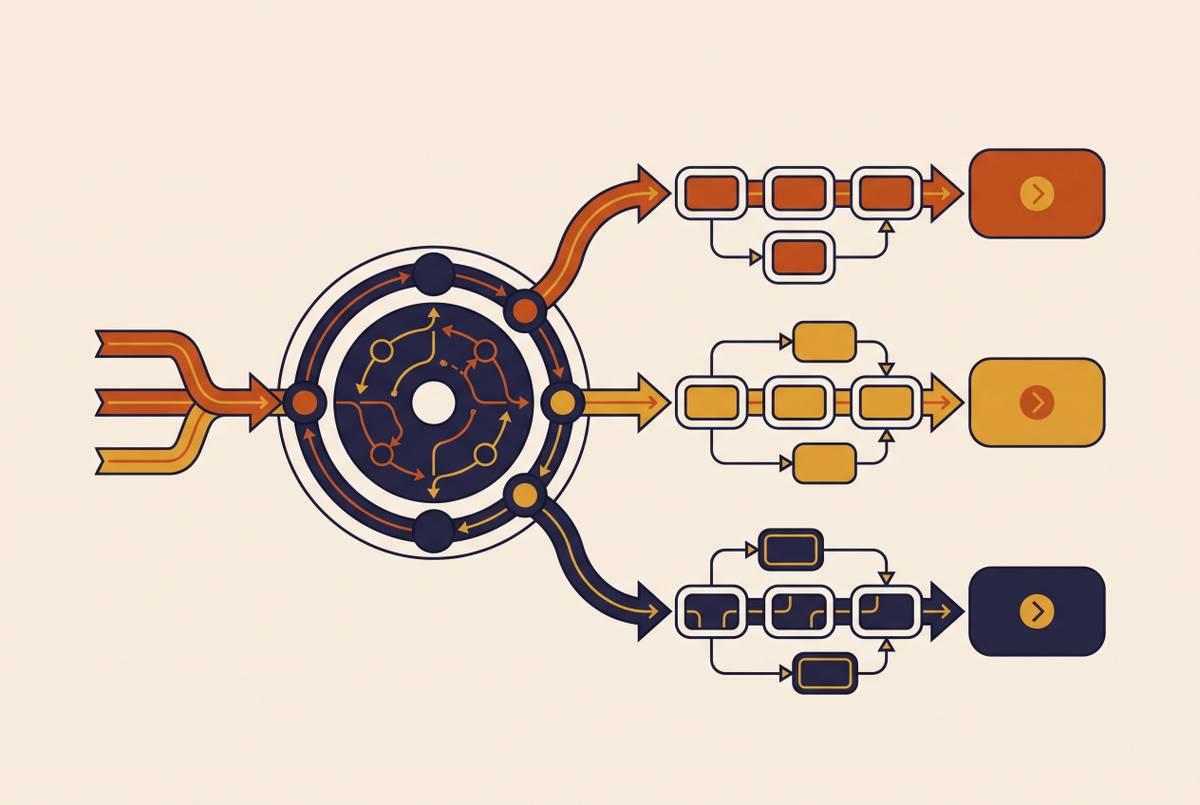
A centralized infrastructure layer, usually called an AI gateway, sits between application services and the LLM providers they call, closing the gap. It handles routing, load balancing, fallbacks, authentication, rate limiting, cost tracking, caching, and observability for all LLM traffic in one place. The provider key lives in the gateway, not scattered across application code, which is the single architectural change that makes everything downstream of it possible.
A gateway has to carry six jobs, and they work together rather than standing as a checklist of separate features. The first is unified provider abstraction: application code calls one API, and the gateway decides which provider and model actually receive the request, so swapping a provider means changing a configuration file instead of rewriting and redeploying application code. What's new is that one system owns all of them consistently, instead of five teams each reinventing a slightly worse version on their own.
The fourth is caching, and this is where real money gets left on the table without anyone noticing. At production scale, system prompts can eat a large share of total input tokens, so caching them properly can be close to the single largest unclaimed discount sitting inside most AI bills. The fifth is per-request observability: tracking input tokens, cached tokens, output tokens, model, route, latency, and cost, attributed down to the feature and team that generated the request. Without that, every cost conversation turns into an investigation you run after the money is already spent. The sixth is rate limits and virtual keys, enforced at the gateway because it's the one place that sees every request across every team, which is what stops a single runaway agent loop from generating a surprise bill overnight.
Taken together, these six functions are what turn a second vendor contract into something that actually reduces risk instead of just adding a line item.
Routing Strategy Converts Provider Exposure Into an Adjustable Decision
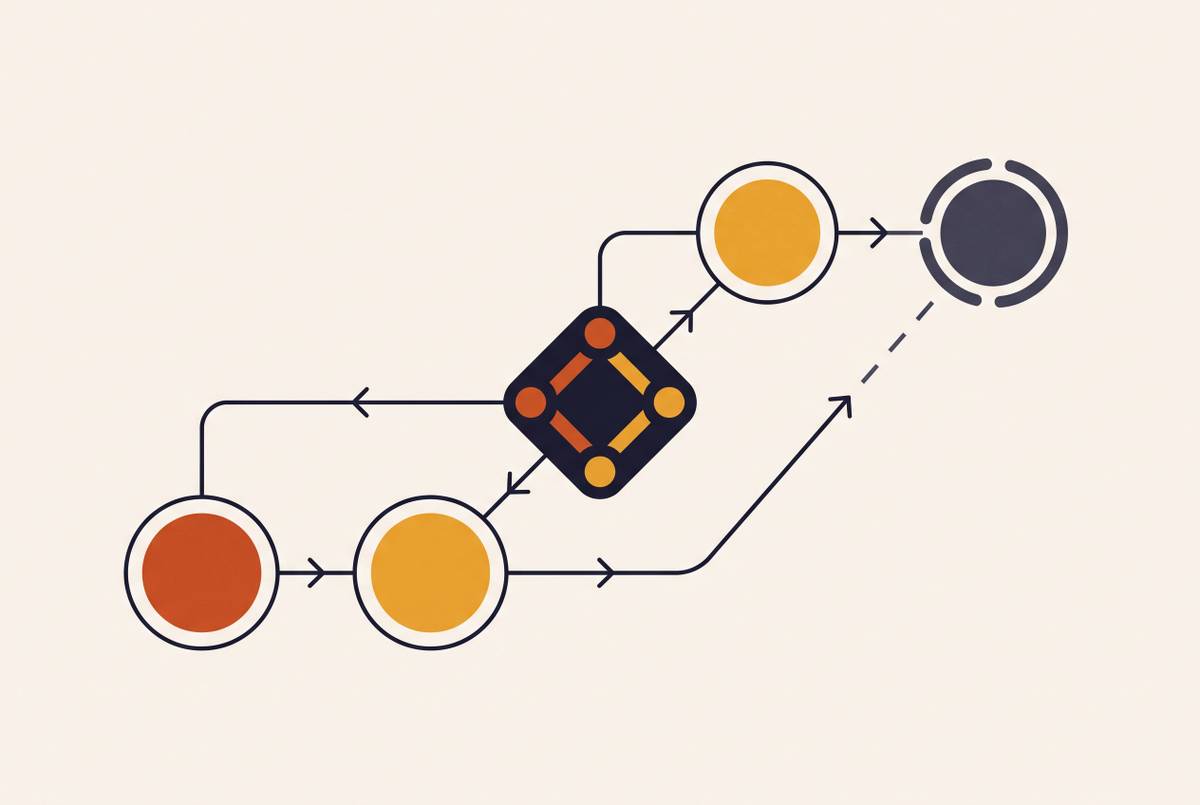
Of the six functions a gateway carries, routing does the most direct work against concentration risk. It's the mechanism that takes a fixed structural condition, being locked into one provider, and turns it into a decision that can be changed, tested, and reversed without anyone touching application code.
An AI model router inspects each incoming prompt and sends it to the most suitable model or provider based on rules, cost, latency, or how complex the query is. Fable 5 and Mythos 5 faced an export-control restriction in mid-2026. It becomes a configuration update, made calmly, by someone who is looking at a dashboard rather than fighting a production incident.
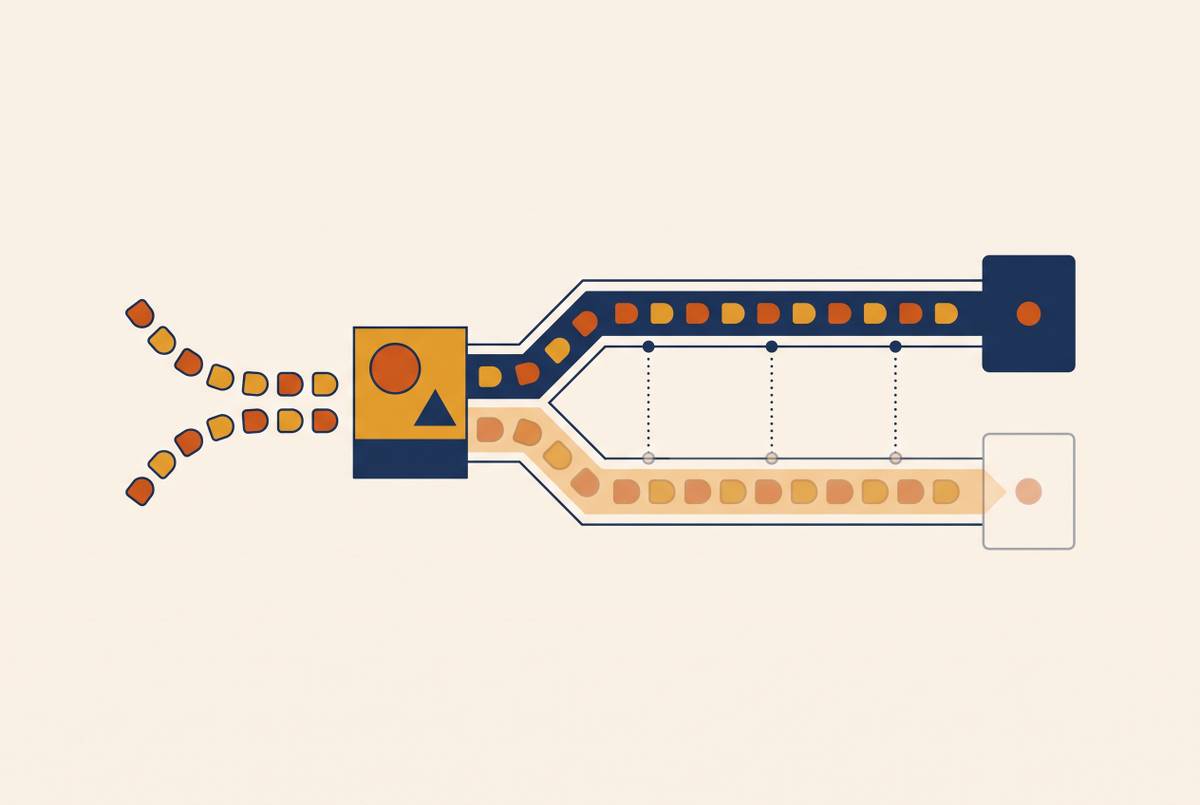
Routing isn't free of caveats. GPT-4o, Claude 3.7 Sonnet, and Gemini 2.5 Flash all accept OpenAI-compatible message formats, but they don't respond to system prompts the same way, so fallback logic has to account for that difference. The practical conclusion is to test fallback paths before they're needed, not during an actual outage, when there's no time left to discover that a backup model handles instructions differently than expected.
Production data documents fallback logic rescuing a meaningful share of requests, and an even larger share of tokens, that would otherwise have simply failed. And the overhead concern that holds some teams back doesn't hold up under the numbers. Most published gateway latency benchmarks test against mock upstreams rather than real provider traffic, but actual LLM responses take somewhere between 500 milliseconds and 3 seconds, so a gateway that adds under 50 milliseconds of its own overhead is effectively invisible inside that range.
Routing is also the sharpest tool available for controlling cost, not just availability.
The spend visibility and governance controls that make multi-provider routing sustainable
Routing across several providers solves the availability problem, and on its own it opens a different one. Without real-time cost attribution and enforced budgets sitting alongside it, a team trades concentration risk on availability for a new kind of exposure: spend that nobody is watching and usage that finance and security teams can't see until the invoice arrives.
Token spend moves in direct proportion to usage, to how complex prompts get, and to agentic workflows that chain several model calls together to complete one task. Controlling this well rests on four things working together: tracking tokens, models, latency, and cost at the level of each individual request, attributing that cost to the team, product, or customer responsible for it, optimizing through routing and caching and right-sizing which model handles which request, and governing all of it with limits that are actually enforced automatically. That last piece means setting token or monetary limits per agent, per API key, per team, or per user group, with an automatic pause or kill switch the moment a threshold is crossed, rather than a limit that exists only in a policy document. LiteLLM's v1.100.0 release, from September 6, 2026, pushed this further by turning the spend limit into something shared across a whole group of deployments: a model access group now gets one budget enforced across everything in that group, tracked in a per-window spend table, with over-cap spend optionally rolling into the next window rather than simply being blocked.
None of this holds up if the governance features are hard to reach. When budgets, role-based access control, and similar protections sit behind enterprise-tier contracts or configuration complexity that only a specialist can manage, teams don't wait for permission. They route around the friction, and that workaround is precisely how shadow AI spreads inside organizations that believe, often sincerely, that governance is already in place. An organization with invisible usage sitting outside its own controls has simply recreated the concentration risk at a different layer: a dependency nobody can see is still a dependency.
Data Security Requirements in a Multi-Provider Architecture
Spreading requests across more providers doesn't shrink the attack surface for sensitive data. It grows it, because every additional provider in the routing path is one more endpoint that could end up holding something it shouldn't, which makes centralized control over what leaves the organization more important precisely as the provider list grows, not less.
Putting PII redaction and access control at the gateway layer rather than leaving each team to handle it independently avoids the same fragmentation problem that made coordinated failover impossible. A production-grade approach to this runs in layers rather than relying on one method to catch everything. Regex checks run against every request, and they catch known structured patterns like phone numbers or account numbers. Named-entity recognition runs against every request that touches free-form text, and it catches the unstructured cases regex can't reach. LLM-based redaction is reserved for flagged samples or genuinely high-risk pathways, because it carries its own cost and latency.
This layered structure matters for the same reason the rest of the gateway does: it puts one consistent policy between every application and every provider, instead of leaving data protection to whichever team happened to write the integration last. The gateway is where the organization gets to decide what leaves its boundary, on every request, regardless of which provider ends up on the other end of it.
Sources
- AI Gateway Architecture: The New Infrastructure Layer for LLM Apps (2026) - ArchitectureDiagram.ai
- AI Provider Concentration Risk: Enterprise Resilience – Lab Space
- AI Development Stack Concentration Risk – Lab Space
- AI Compute Concentration and Systemic Risk – Lab Space
- AI Gateway & LLM Gateway: How They Work and What They Miss
- Artificial Intelligence: Supply-Chain Chokepoints and the Reach of Industrial Policy
- LLM Gateway Design Guide (2026): Architecture, Trade-offs, and When to Build vs Buy
- AI concentration: a board-level risk | Control Risks