Shadow Mode Testing for LLM Routing Changes
Catch model routing failures on real traffic before users encounter them.
A team swaps one model for a newer one on a Tuesday afternoon. By Thursday, support tickets are up. Nobody can point to a single broken feature. The new model just handles edge cases differently, and formats dates in a way that quietly breaks a downstream parser. The team reverts, and two sprints of work disappear with it. The model itself may have been fine on most requests. The release process is what failed.
Code deployments fail loud. An LLM routing change can pass every one of those checks and still do damage: it can return a clean HTTP 200 while task completion quietly drops, a JSON schema breaks, the model picks the wrong tool, or token cost on long prompts doubles. The failure is rarely a clean outage. It's a slow erosion of quality that nothing in a standard pipeline is built to catch.
Non-determinism makes this worse. Accuracy on identical inputs can swing across runs, and researchers trace the cause to batch-size variability, which shifts the order floating-point operations get reduced in on GPU kernels. Floating-point math isn't associative, so when that order shifts, you get a different answer. If a unit test expects one right answer, it has nothing to grab onto here.
Feedback also arrives late. A 500 error gets caught within seconds, by a monitor or an on-call engineer. A bad LLM output is often discovered only hours or days after it first shipped, through a user complaint, a broken downstream pipeline, or a support ticket. One team that pushed a candidate model straight to 100% of traffic without staged validation found out the hard way: function-call accuracy dropped 9 points and refusal rate climbed 7, and neither number was visible until the flip was already live.
Cost behaves the same way. Swapping models changes token spend, and discovering a cost spike only once a model is serving full traffic is an expensive way to learn.
Agentic systems raise the stakes further. A single user request in an agent pipeline might trigger retrieval, planning, several tool calls, memory writes, and a final answer. If a routing change pushes the new model to pick a different first tool, that can trigger a schema-validation failure three spans downstream, or it can set off a cascading failure across a multi-agent handoff. None of that is visible as a crash; instead it appears as a wrong answer, three steps removed from the decision that caused it.
Shadow mode exists because the only way to know what a model actually does is to score it against real traffic before any user ever sees its output.
Shadow mode at the gateway layer
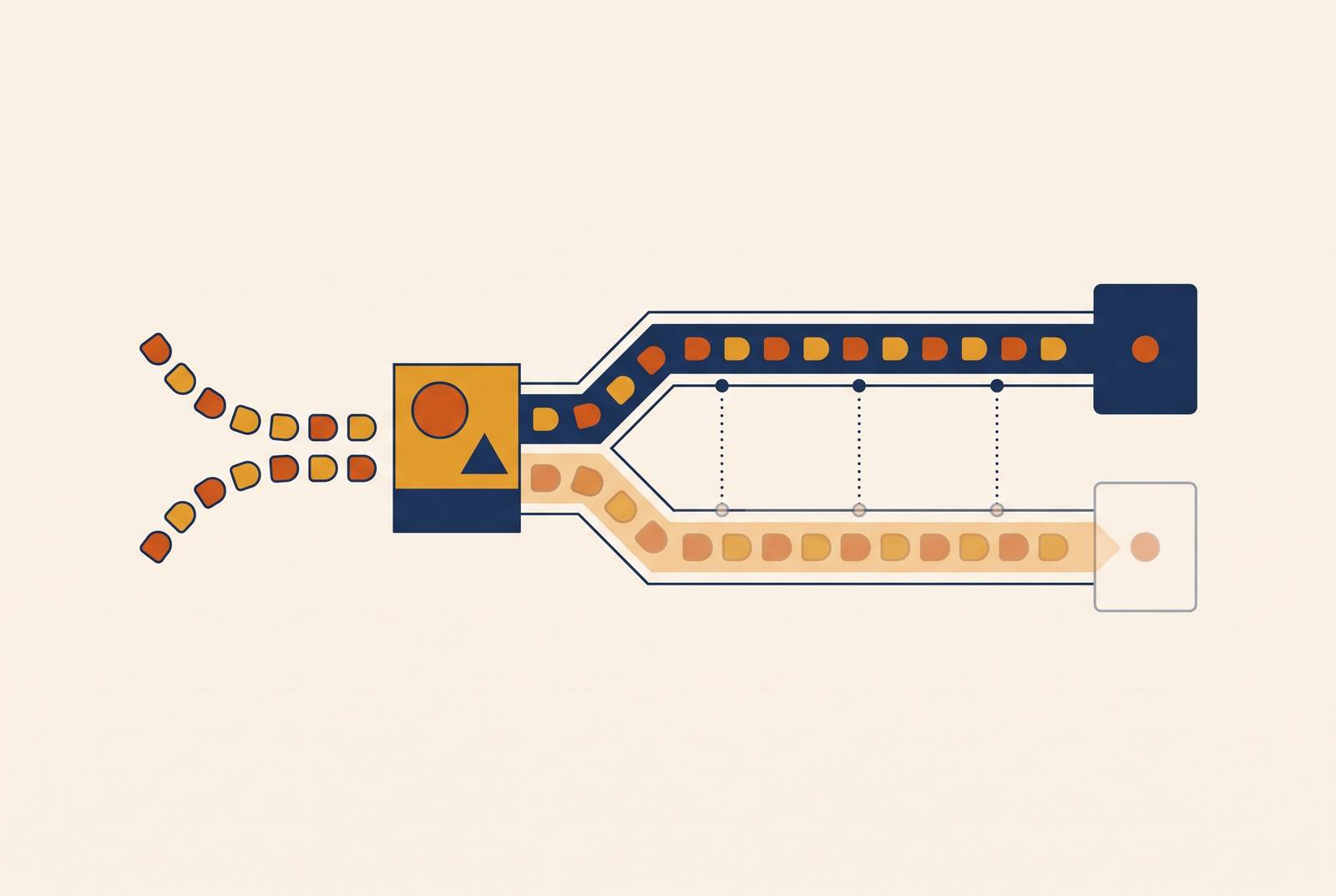
Shadow mode runs a candidate model alongside production on real, mirrored traffic, but you never see what it outputs. The production model still answers the request. A copy of that same request gets sent to the candidate at the same time, and the candidate's output gets logged, scored, and compared, but it never touches the response a user actually receives.
This is only possible because of how an AI gateway sits in the request path. The gateway works as a reverse proxy for model APIs: applications send requests to one endpoint, and the gateway handles which provider answers, checks auth, and enforces policy, all without the application needing to know any of that is happening.
Both the production response and the shadow response come back tagged with a shared correlation ID. The user only ever sees one of them. The platform sees both, as a scored pair, ready for comparison.
Shadow mode is a distinct thing from blue-green deployment and from canary deployment, and the distinction matters. Blue-green swaps an entire environment over at once. With canary, a small percentage of real users get the candidate's actual output, and a rollback path stays ready if something goes wrong. Shadow mode does neither. It never serves the candidate's output to a real user, and it never swaps anything. Observation happens before exposure.
That constraint has to be enforced at the infrastructure layer, not left to application logic. A shadow result can't reach the caller, update any application state, populate a production cache, or trigger a proposed tool action. These have to be gateway-level rules, because if you put the constraint in code instead of infrastructure, an application developer under deadline pressure might accidentally let a shadow response leak through.
Shadow mode applies any time a change is "major enough" to need a real answer before production sees it: restructured prompts, new tool schemas, changed guardrail policies, and changed fallback routes all qualify. Minor prompt tweaks generally don't need this level of ceremony. Shadow and canary both act as eval gates on real traffic, but they answer different questions: shadow tests the distribution of outputs, canary tests outcomes with actual users in the loop. One useful variant is fallback shadow testing, where a controlled copy of an eligible request goes to a standby route while the approved primary route stays the only source of the user-facing answer. That shadow result is evidence to evaluate later, never an emergency substitute in the moment.
None of this requires touching application code, because the fork, the correlation ID, the scoring subscription, and the eventual promotion gate all live in the gateway layer, as infrastructure rather than as something each team has to build into its own service.
What to measure during the shadow phase
Shadow mode by itself produces nothing more than a large pile of logs. What turns that pile into a decision is a scoring layer that runs automatically on every mirrored pair, and the minimum viable version of that layer is an LLM judge evaluating both responses against criteria that actually matter for the use case. Without that judge, a team is comparing impressions, not evidence. The scoring also has to run on the same rubric for both the incumbent and the candidate, because scoring one side on groundedness and skipping it on the other makes the comparison meaningless. A sensible default is to use multi-dimensional rubrics with majority-vote aggregation across guardrails, so one noisy evaluation template can't flip the result for a whole cohort of traffic.
From there, the signals split into two groups, and each one catches a failure the others would miss. The first group covers what the model produces. Groundedness and context adherence check whether the response stays faithful to retrieval context, so a drop here warns you of hallucination before any user sees it. Task completion checks whether the candidate does what you asked, because a model can sound fluent and still be wrong. For agentic workloads, you check function-calling accuracy: does the candidate pick the right tool, pass valid arguments, and return output that matches the expected schema? Refusal rate matters on its own, separate from quality scores: a new model might start refusing a category of requests the old one handled fine, and that shift appears in user experience long before it appears anywhere else. JSON schema validation catches structured-output regressions that would otherwise break a downstream parser or tool contract silently, invisible until something built on top of it fails.
The second group covers how the model behaves under load, and these numbers answer a different question entirely: not whether the output is good, but whether the system serving it holds up. Latency has to be measured in percentiles, p50, p95, and p99, rather than as a single average, because LLM latency distributions skew heavily and an average hides exactly the tail behavior that matters. Timeout rate, retry count, and provider error rate show you reliability gaps between providers that an aggregate latency number would smooth over. Token cost per trace matters because if a candidate scores better on quality but costs noticeably more per request, you need to understand and budget for that before it reaches full traffic.
These numbers mean little as a single blended average across all traffic, because a candidate can pass overall while failing badly on one specific route, tenant, language, or tool path, and a safe-looking average hides a regression affecting one enterprise customer. Segmenting by tenant, route, prompt version, and intent is what catches a model that handles simple queries well but breaks down on a specific customer's edge cases, before that customer ever reaches canary. The shadow capture rate itself, observed shadow calls divided by eligible requests, should land within a known tolerance of whatever sample rate was configured. A gap between the two signals a routing or infrastructure problem rather than the candidate behaving oddly.
Mirror sampling as the practical middle path between full duplication and no shadow
The honest objection to shadow mode is cost: running every production request through a second model doubles inference spend for as long as the shadow phase lasts. Mirror sampling is the answer, and it works by running shadow traffic on a fraction of total requests rather than all of them, which cuts the overhead while still producing enough scored pairs to catch regressions at the distribution level.
The naive alternative is a live split across heavy traffic volumes sustained for two weeks, and at 2026 list prices for frontier models, that generates substantial arm overhead just to get a read. Running shadow traffic at a lower sample rate, combined with bandit-style allocation once a candidate starts proving itself, cuts that cost materially while still producing a usable signal.
Mirror sampling is a trade, not a free lunch. Running at a fraction of full traffic gives you enough signal to catch broad regressions, but fewer unusual, edge-case prompts get scored than full duplication would surface. The right sample rate depends on how much traffic a system handles and how long and unusual the tail of that traffic actually is. If a system has a short, predictable traffic distribution, you can run a low sample rate safely. A system with a long, varied tail needs a higher rate, or it risks missing exactly the edge cases that caused the support-ticket spike in the first place.
Getting a valid read out of mirror sampling depends on sticky routing: if the same user's requests bounce between the shadow arm and a control arm across a session, the resulting signal mixes both arms together and the comparison can never reach statistical significance. This has to be enforced where session-level identity actually lives, at the gateway layer, not patched in after the fact inside an evaluation pipeline.
A practical way to sequence the rollout starts even before the shadow pipeline is live: replay historical production requests through the candidate model first. That gives you a fast read on likely regression areas before a single live request is mirrored. Once that pass looks clean, you can activate shadow mode at a low sample rate against current traffic, and increase the sample rate only as confidence builds.
Sequencing the transition from shadow to canary to full rollout
Clearing shadow mode earns a candidate the right to enter canary. It doesn't replace canary, and treating the two as interchangeable is a mistake, because they test different things entirely. A candidate that wins on groundedness during shadow can still lose on retry rate once it reaches canary, and that's not redundancy, that's two different failure classes being caught by two different gates. Canary's job is to measure outcomes with actual users in the loop: feedback rate, retry rate, and escalation rate are all signals that only exist once a human is actually receiving the candidate's response, and shadow mode, by design, can never produce them.
Each gate in this funnel needs to be set in advance, as a number, not judged informally once results start coming in. Sample floors per arm and minimum window durations should be declared before the experiment even starts, and promotion shouldn't be allowed to trigger until both thresholds are cleared. That gate belongs in the gateway itself, not in a deploy script a developer can skip under pressure. The failure mode this guards against is a familiar one: a team promotes a candidate four hours in because the early numbers look good, only to find the full picture was worse. The gate exists specifically to stop that from happening. Rollback needs the same discipline: it has to be a single config change at the gateway, not a redeployment, because a bad prompt running at full traffic racks up cost and damage within minutes unless the system can flip back automatically.
There are two ways teams get this sequence wrong. Skipping shadow means the first time a candidate touches a real user is also the first time the team discovers its failure modes. Skipping canary means a team waits indefinitely for offline numbers to converge instead of putting the candidate in front of real users with a rollback path ready, and a prompt edit that should have shipped in a week stalls for six.
One more mode is easy to confuse with shadow or canary: the race pattern, where both the incumbent and the candidate answer the same request at the same time and whichever response comes back faster is the one served to the user. It's a useful tool for latency-bound SLOs, but it's a genuinely different thing from shadow and canary, since in a race, both responses are eligible to reach the user.
What shadow mode cannot catch
Shadow mode and canary both validate a candidate, but only during a specific window of traffic. Once the candidate clears that window, reaches full rollout, and the shadow pipeline comes down, nothing is actively comparing its answers to anything. The promotion funnel was built to catch a regression at the moment of change, and it does that job well. It was never built to keep watching after the change is finished.
Model behavior doesn't stay fixed just because a rollout is complete. A provider can update weights behind an API without renaming the model, traffic patterns can drift away from whatever shape the shadow phase sampled, and a new edge case can show up in production six months after the last shadow comparison ran.
The gap this leaves is why continuous, per-request verification matters as a complement to the shadow-to-canary funnel rather than a replacement for it. Where shadow and canary answer "is this candidate safe to promote," ongoing verification keeps asking a narrower, repeating question: "is this response, right now, still acceptable," on live traffic long after the rollout finished. The promotion funnel earns a candidate its place in production. Verification is what keeps checking that it still deserves to stay there.