Per-Team LLM Access Controls With Spend Limits and Full Usage Visibility
An LLM gateway enforces per-team budgets and usage limits before costly API calls reach providers.

When several teams share access to large language models through direct provider accounts, the result is a familiar mess: API keys scattered across applications, spend that no one can trace, and policies that differ from team to team. The fix is an LLM gateway, a single chokepoint where per-team keys, budgets, and usage logs live together. Getting that architecture right is what separates controlled scaling from runaway costs and blind spots.
Why shared LLM access breaks down without a control layer
Direct provider integrations are not a scaling model. They are the absence of one. Each team manages its own provider credentials, its own SDK calls, its own rate-limit handling, and its own retry logic. Provider complexity bleeds into application code separately for every team, so the same engineering problems get solved five or six times over.
The cost side is worse. A misconfigured retry loop or an unbounded agent can generate large API charges before anyone reviews a dashboard. The problem surfaces at the invoice, not at the request. By the time finance sees the number, the spend has already happened.
Observability sits in per-provider dashboards, so you cannot see an internal cost-per-team view. There is no cross-provider aggregation, and no way to see which team or feature drove a spike. Providers can tell you what you consumed on their platform. They cannot tell you why.
This compounds as teams add AI agents. Each agent issues multiple model calls per task, so the volume of uncoordinated access grows quickly. The gateway pattern exists because without a shared abstraction layer, every team rebuilds routing, fallback, and observability logic on its own, and every team absorbs the operational risk when a provider goes down.
What an LLM gateway is and where it sits in a production AI stack
An LLM gateway is a purpose-built intermediary between applications and providers. It exposes one unified API on one side and handles routing, policy enforcement, cost accounting, and observability in the middle. That position makes it the natural chokepoint for team-level governance.
The gateway is not a generic API gateway. It is model-aware, token-aware, and prompt-aware. It understands the economics of an LLM call, including token counts and per-model pricing, not just HTTP request counts. That distinction matters because a request that costs two cents and a request that costs two dollars look identical to a standard proxy.
A production gateway handles a concrete set of functions. It normalizes provider APIs, routes models, manages fallbacks, and accounts for token and dollar cost on every request. It enforces rate limits and quotas, vaults provider keys, redacts PII, and writes audit logs. These are not optional extras. They are the core of what makes shared access governable.
Crucially, the gateway does not replace provider relationships. It mediates them. Provider complexity lives in one infrastructure layer instead of in every application, so a provider change or a pricing update does not force a change in application code.
The virtual key: the primitive that makes per-team control possible
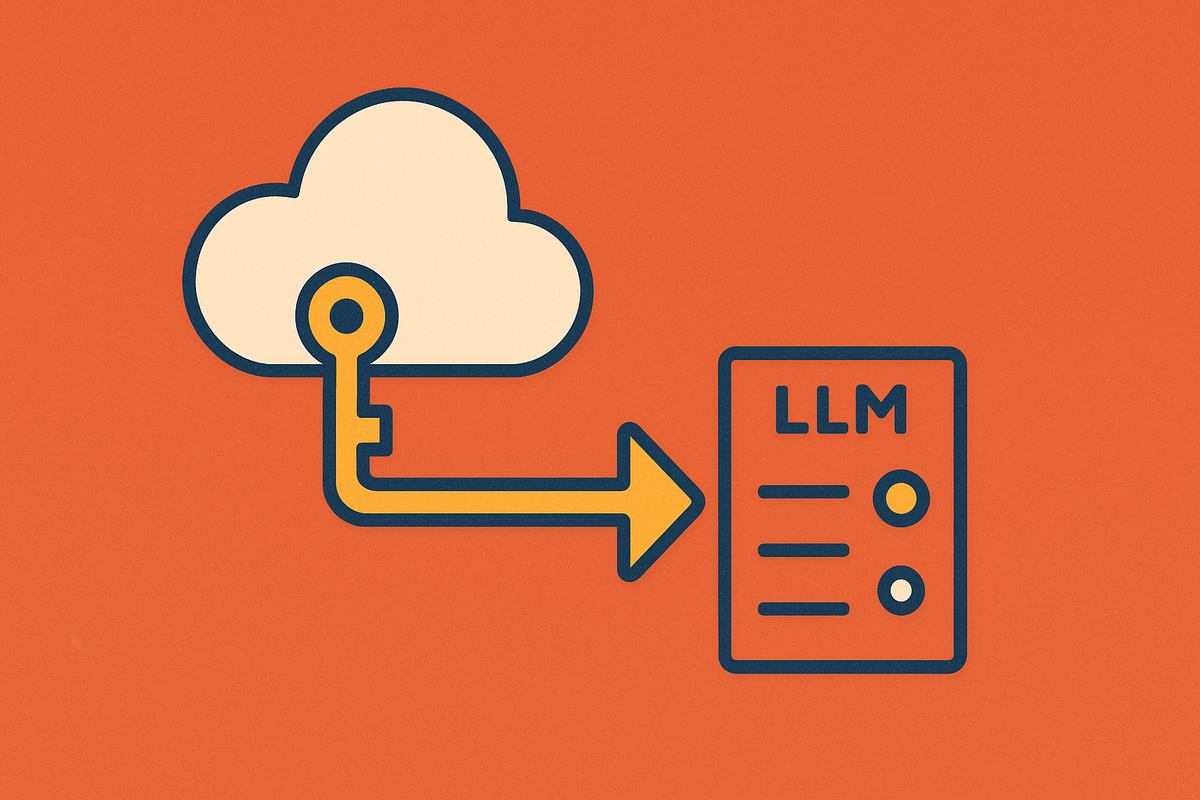
The mechanism that turns a gateway from a routing proxy into a governance tool is the virtual key. A virtual key is a gateway-issued credential that stands in for a real provider key. The real provider keys live in the gateway's secret store and never appear in application code. Each team or service receives its own virtual key instead.
Here is what changes operationally. When a request arrives, the gateway authenticates the virtual key, swaps in the real provider key, applies the team's policy, and forwards the call. Revoking a team's access, changing their budget, or moving them to a different underlying provider becomes a gateway configuration change. It is not a code deployment.
Each virtual key carries its own dollar budget, token and request rate limits, reset schedule, and model access policy. Governance travels with the credential, not with the application. That is the structural difference. Direct provider keys carry no policy at all.
Virtual keys also make hierarchical budgets enforceable. Per-key, per-team, per-project, and per-organization limits can coexist, so a single org-wide cap does not hide which team is driving spend. And because the key is a gateway object, it can be disabled instantly. A runaway agent or compromised credential is stopped at the gateway before more provider charges accrue. Virtual keys issued by a gateway, such as the ones Concentrate AI provisions for each team or service, carry their dollar budget, token limits, and model access policy baked in. Adjusting a spend cap or revoking access becomes a gateway configuration change, which is why governance is structurally enforced rather than left to process or developer discipline.
How per-team spend limits work and what "enforcement" actually means
The phrase "spend limit" only means something if the limit is checked before the provider call. A gateway that tracks spend after the fact is a reporting tool. A gateway that blocks overage before tokens are consumed is a control plane. The sequence is simple: every request passes through a budget and rate-limit check first, and a request that would exceed the limit is refused. The spend never happens.
Provider dashboards tell you what you already spent. That is cost reporting. A gateway that refuses the over-limit request is cost control. The structural difference matters because monthly visibility cannot prevent a retry loop from running up charges overnight.
Four mechanisms make enforcement work. Dollar budgets with reset schedules, hourly, daily, or monthly, attach to a key or team. Token-per-period and request-per-period rate limits stop volume spikes before they become cost spikes. Per-request cost attribution tracks actual token counts and model pricing. Alerting fires as a budget fills, not after it overflows.
Granularity matters more than teams expect. A single org-wide cap stops total overspend but cannot identify which team, feature, or customer caused it. Hierarchical limits, per key, per team, per project, are what enable chargeback and informed optimization. Concentrate AI operates here as a fully managed gateway with near-real-time spend tracking by team, project, key, model, and provider, with no markup or platform fee, which gives engineering and finance teams the granular view provider dashboards cannot provide without a platform team to operate it.
What real-time usage visibility looks like across teams, models, and providers
Spend visibility needs to be real-time and attributed to the team, project, key, model, and provider that generated it. Reconstructing that picture from end-of-month invoices is too late to change behavior or catch anomalies. The attribution gap in provider-native dashboards is structural, not a dashboard UI problem. Providers know their own aggregate token volumes. They do not know your internal team boundaries.
A cost regression should be caught the way a performance regression is caught, in hours or days rather than at the monthly invoice. That requires the gateway to emit per-request cost data in real time. When teams see their own cost-per-task trend alongside their quality metrics, cost-aware habits form naturally. When only finance sees an aggregate bill, the response is a blunt mandate that usually degrades quality.
Granular attribution enables specific things. It supports chargeback to business units, forecasting by team or product line, and identifying which model or workflow is the largest cost driver. It also catches anomalies like retry loops and runaway agents before they compound. The observability requirement for a production gateway includes per-request metrics for latency, error rate, token usage, and cost, plus traces from request entry to provider response. Aggregate counters are not enough.
Access control beyond budgets: RBAC, audit logs, and policy enforcement per team
Budgets address spend. Governance also requires controlling which models each team can call, who can change those policies, and producing an immutable record of every access decision. Role-based access control at the gateway level handles the first part. Different teams get access to different model sets. A customer-facing team may be restricted to approved models while an internal research team has broader access. The policy travels with the virtual key.
Model access restrictions are also cost governance. Preventing a team from calling a frontier model by default is a policy decision, not just a budget one. A generous budget and unrestricted model access are different risks.
Audit logs must be immutable, complete, and exportable. They record who did what, when, which model was called, and which data category was involved. They record the guardrail event and the data category, not raw prompt content or PII. A compliance-grade log captures authentication events, access to regulated data, configuration changes, and access to the logs themselves. That maps directly to requirements under frameworks like NIST AI RMF and CMMC.
PII and PHI redaction should run at the gateway, one chokepoint enforced by policy rather than developer discipline, reviewable per request. Sensitive data never reaches model providers regardless of which team's application made the call. For teams handling PHI, a HIPAA-compliant gateway with a business associate agreement is a structural requirement, not an enterprise-only concern. SSO and centralized key management mean that when an employee leaves or a team changes scope, access is revoked in one place instead of tracked across a dozen provider accounts.
Routing and fallback as governance, not just reliability
Routing and fallback sound like reliability topics, but they are governance levers first. Which providers a team's traffic can reach, under what conditions it can fall back, and what happens during an outage are all policy decisions, not just engineering ones. Policy-based routing lets platform teams restrict which providers a given team's virtual key can reach. A team handling sensitive data may be routed only to providers covered by a BAA or zero data retention agreement, regardless of what the application requests. Zero data retention is itself a routing decision. Blocking certain providers for certain data classes, routing regulated data to self-hosted models, and enforcing residency constraints are all configurable at the gateway without application code changes.
Fallback tiers carry governance weight too. A tiered fallback that keeps quality consistent, such as trying Sonnet on Anthropic, falling back to Sonnet via Bedrock, then to an equivalent model on another provider, is different from a static chain that may silently degrade quality or route sensitive data to an uncovered provider. When one provider goes down, automatic fallback across providers serving the same model keeps the product online without a code change. But the fallback list should be governed by the same policy that governs primary routing. Concentrate AI handles this with built-in automatic fallbacks across providers and models, with routing decisions optionally logged per your policy, so the fallback path is auditable rather than invisible.
Build vs. buy: self-hosted open-source gateways versus a managed gateway
The build-versus-buy decision for a gateway is really a question of where the operational burden lives. Self-hosting gives control and data residency, but running gateway infrastructure is a continuous engineering commitment that competes with shipping product. Self-hosted open-source options are credible choices. LiteLLM offers virtual keys with per-project spend limits and strong provider abstraction, which suits teams that want data to stay in their own infrastructure. Bifrost is built in Go for high-throughput workloads, supports hierarchical budgets, and runs self-hosted or in-VPC, which suits regulated workloads requiring air-gapped or on-prem deployment.
The real cost of self-hosting is the ongoing work. Deploying and operating a gateway proxy means version upgrades, capacity planning, and incident response, all of which fall on the engineering team and compete with product development. A managed gateway removes that operational burden. Concentrate AI is fully managed, so there is no proxy to deploy or maintain. Engineering teams get the control-plane capabilities, virtual keys, per-team spend tracking, RBAC, PII redaction, fallbacks, and audit logs, without operating the infrastructure.
The fee model changes the calculus. Concentrate AI charges no markup, no platform fee, no card fee, and no BYOK fee. Customers pay for tokens, so the managed option does not add a cost layer on top of provider pricing. For regulated teams in healthcare, fintech, legal, or insurance, SSO and audit logs are available to a five-person team on day one without an enterprise contract. A BAA, required for a fully HIPAA-compliant deployment, is listed under Concentrate AI's Enterprise tier. The evaluation criteria that matter most are governance depth, deployment model, compliance posture, and whether the platform team has bandwidth to operate proxy infrastructure.
What "controlled scaling" looks like when the gateway is the control plane
When the gateway is the control plane for team-level AI governance, scaling from a handful of teams to many more does not require rebuilding access controls. It requires issuing new virtual keys with the policies already defined. Adding a new team means creating a virtual key, attaching a budget and rate limits, and assigning a model access policy. The new team is governed from day one. No new provider accounts, no new SDK integrations, no new audit configurations.
Finance and security get what they need without depending on engineering. Finance sees real-time spend by team and model. Security sees an audit log of every access decision and redaction event. Neither requires a bespoke data pipeline.
Provider outages become a configuration event rather than an incident. Fallback routing across providers serving the same model fires automatically, every routing decision is logged, and the on-call engineer does not touch application code. The governance layer is independent of the application layer, so teams can swap models, change providers, or adjust budgets at the gateway without a code deployment. That is the operational definition of provider complexity living in the infrastructure layer.
The alternative does not stop being a problem at two teams. Letting each team manage its own keys, budgets, and provider logic becomes progressively harder to audit, control, or recover from as the number of teams and models grows. The gateway is where that stops.