One Endpoint to Route All Your LLM Provider Calls Without Credential Sprawl
A unified gateway centralizes credentials and routes all LLM calls through one policy layer.
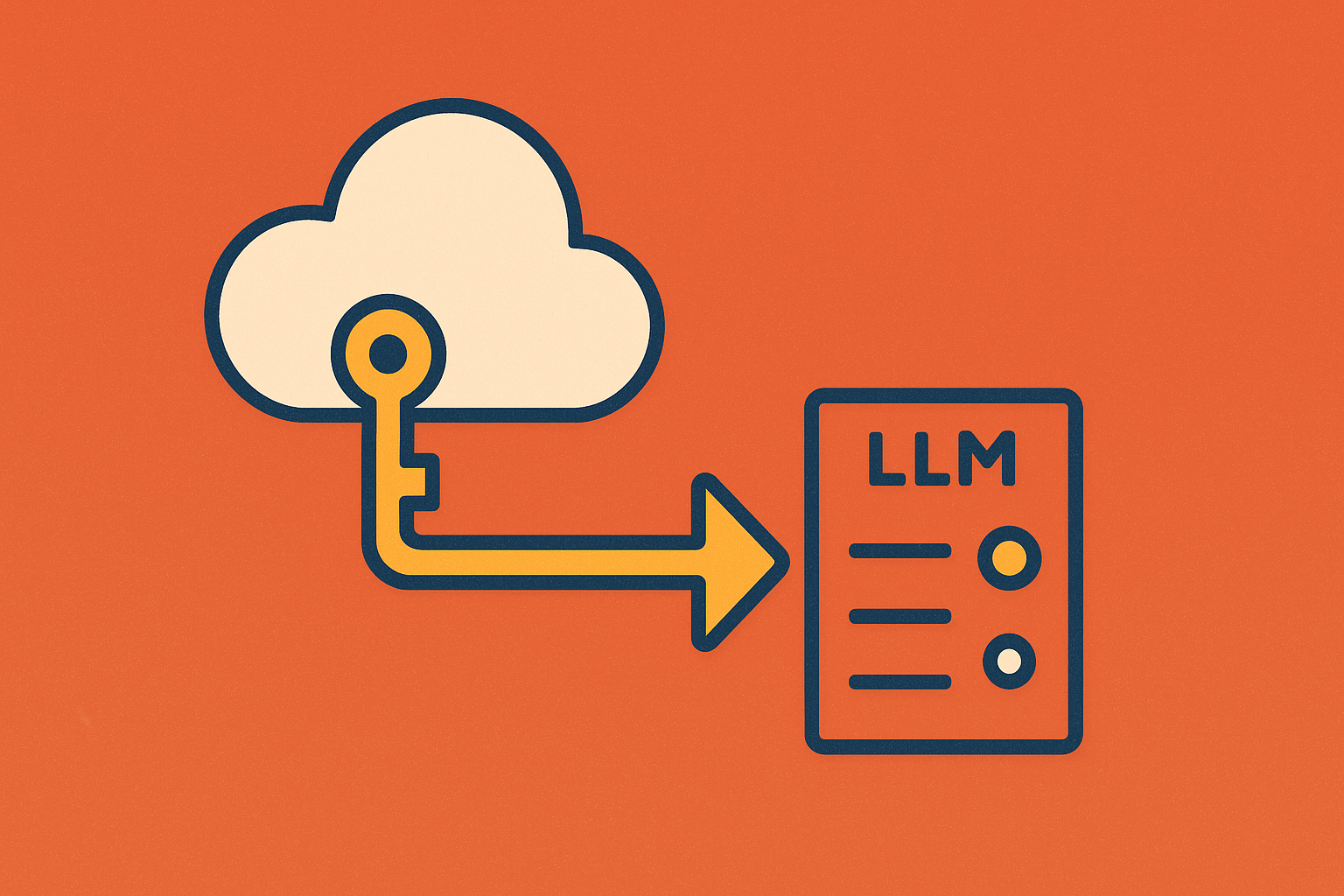
One team wires up OpenAI. Another builds against Anthropic. A third stands up AWS Bedrock because a regulated workload needs it. Each of those integrations needs its own API key, its own SDK, its own authentication code, and its own billing relationship with the provider. Every team, every service, and every pipeline that touches a model adds its own credentials, so the number of live ones in an organization grows faster than anyone tracking them by hand can keep up with.
That's what credential sprawl is: not a lapse in discipline, but the direct output of connecting to multiple providers one integration at a time. Each team manages its own keys, sets its own budgets, writes its own retry logic, and keeps its own logs. Nobody has a single view of what model usage looks like across the company, because nobody built the system to produce one. Governance doesn't fail here, it was never present as a shared layer to begin with.
The keys themselves scatter into predictable places: application code, environment variables, CI pipelines, engineers' local config files. Each of those is a distinct exposure surface, and none of them share a revocation path. Find a key hardcoded in a repository and rotating it doesn't help if three other copies of it are sitting in a CI secret store and an engineer's laptop. Every direct integration adds another location where a credential can leak, and another place someone has to remember to update when it's time to rotate.
The pressure only grows as AI usage accelerates inside a company. The teams moving fastest today have put a gateway layer between their applications and every provider, and that layer stops the sprawl before it starts. That's the architectural shift this piece walks through.
The LLM Gateway's Place in the Request Path
An LLM gateway is middleware that sits between an application and the model providers it calls. The request path looks like this: Application sends a request to the LLM Gateway, and the gateway forwards it to an AI provider or a self-hosted model. From the application's point of view, there's one stable endpoint to call. The gateway handles which provider actually answers the request, how that provider authenticates it, and whatever policy needs to apply, all without the application needing to know any of it happened.
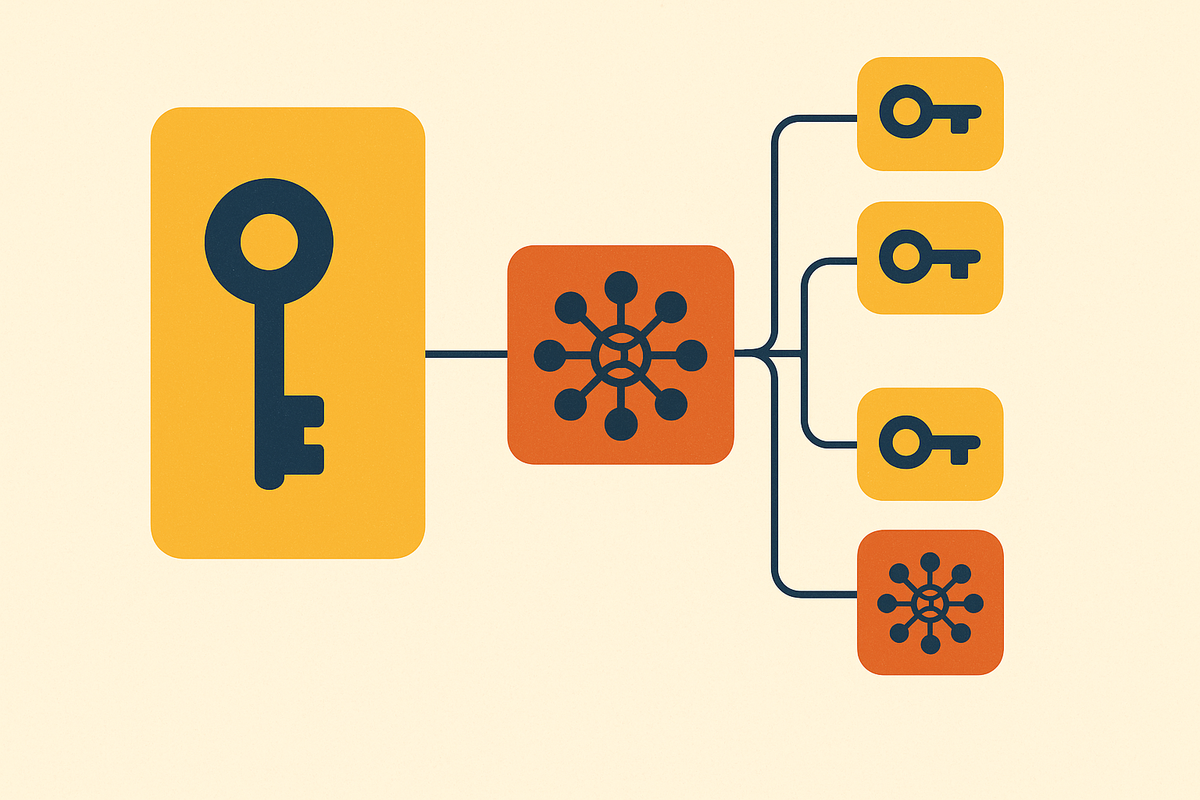
The gateway holds every provider credential centrally, and issues scoped virtual keys to the teams and applications that need model access. Applications never see a raw provider key. They see a key the gateway issued, good for whatever models and budget that key was scoped to.
The interface the application talks to is stable and provider-agnostic, usually an OpenAI-compatible API. That stability is what lets a team switch providers, or add a new one, without touching application code. The gateway absorbs that change, and nothing downstream has to know it happened.
Beyond simply forwarding requests, the gateway takes on a set of jobs that would otherwise get duplicated across every service that calls a model: deciding which provider should handle a given request, limiting usage by token volume rather than request count, retrying or falling back when a call fails, caching semantically similar requests, logging what happened for observability, and enforcing security policy on every request that passes through. Traditional API gateways, built for a different kind of traffic, were never designed to do any of this. Production AI workloads need token-based rate limiting, routing across multiple providers, semantic caching, defenses against prompt injection, and support for the MCP protocol that AI agents increasingly rely on. None of that is a layer that can be bolted onto generic infrastructure after the fact.
Centralizing API key management at the gateway
Centralizing key management at the gateway ranks among its highest-value functions, because it removes credentials from exactly the places sprawl takes hold. Instead of every team holding a live provider credential, the gateway holds all of them, and issues scoped virtual keys downstream.
Consider what rotating a key looks like without a gateway. With a gateway in place, the provider key lives in exactly one place. Rotate it there, and nothing downstream changes. No application redeploys. No service notices.
That shift produces four concrete outcomes. Application code and environment variables never hold a live provider credential, which removes the exposure that repository scans and leaked environment dumps depend on. Keys can be revoked instantly, without touching a single application deployment. Permissions can be scoped tightly, so a virtual key only works for specific models, specific budgets, or specific request types, rather than carrying the full access of the underlying provider account. Provider keys rotate at the gateway, and no application change is required.
The virtual key also draws a clean line between identity and access. A service account or a team's workspace gets a virtual key scoped to whatever models and budget it needs. The real provider credential never leaves the gateway. If a virtual key leaks, revoking it takes one action at the gateway, and no provider credential anywhere in the organization needs to be touched. That's the direct answer to one of the most common security risks in enterprise AI deployment: API keys sitting in repositories, or spread across dozens of engineers with no central record of who holds what.
Routing, reliability, and cost benefits of the unified endpoint
Once every model call passes through one control point, that point can do things that were never practical when each application maintained its own separate connection to its own provider.
Routing is the clearest case. A gateway can send each request to the cheapest model that still clears the quality bar for that particular task, and escalate to a more capable (and more expensive) model only when the task actually calls for it. And it can run fallback chains that trigger automatically the instant a provider returns an error, shifting the request to an alternate provider with no downtime and no engineer paged in the middle of the night.
The alternative is familiar to anyone who has run a service dependent on a single provider: a scramble to reroute traffic manually while a provider outage burns through minutes or hours.
Fallback logic itself breaks into three categories, each covering a different failure mode. General fallbacks handle timeouts, server errors, and rate-limit responses. Content-policy fallbacks handle prompts a provider rejects. Context-window fallbacks handle requests too large for the model that received them. Most ad-hoc, hand-built integrations only cover the first category; the other two failure modes appear in production as unhandled errors until someone builds a patch for them after the fact.
Cost visibility follows the same pattern. Every request that passes through the gateway gets logged with structured metadata: which team sent it, which model handled it, how many tokens it consumed, how long it took, what it cost, and whether a fallback fired. That produces one unified cost record across every provider a company uses, something that's effectively impossible to reconstruct after the fact from separate dashboards at OpenAI, Anthropic, and AWS. And the unit of control for rate limiting matters here too: limiting by token count, not by request count, is the only approach that reflects real cost, because two requests to the same endpoint can differ by orders of magnitude in what they actually cost depending on how long the prompt and the response are.
Semantic caching rounds out the list, and it's a capability that only really works at the gateway layer. Caching semantically similar requests so a repeat question doesn't trigger a new, billable model call is straightforward to implement once, centrally. Implementing that same logic consistently across every application that happens to call a model would mean building and maintaining the same caching system over and over, once per service.
Where data security and compliance enforcement has to happen
The same reasoning that applies to credentials applies to security policy: whatever holds the keys is also the natural place to hold the enforcement rules, because both need to apply to every request without exception.
Security and compliance controls built into individual applications drift over time. A new microservice goes live without the PII filter the older services have. A third-party integration ships with no logging. There's no single record anywhere of what was sent to which model, because enforcement was never centralized, it was copied, imperfectly, from service to service. The gateway is the one place enforcement can be applied uniformly, because it's the one place every request is guaranteed to pass through.
Provider-level controls alone don't close this gap. Neither control redacts personally identifiable information from a prompt before it's processed, because the model needs the actual prompt text to generate an answer. OpenAI released an open-weight Privacy Filter tool in April 2026 that developers can self-host to redact PII before a prompt is sent, which helps, but it still has to be deployed somewhere, and the logical place to deploy it is in front of the provider, at the gateway.
The default retention policy on standard plans carries its own risk. Zero-data-retention exists as an option, but it requires prior approval from OpenAI for a qualifying use case. It is not the default on pay-as-you-go plans. Any team relying on a standard plan without pursuing that approval is retaining data by default, whether or not that matches their compliance posture.
A compliance-grade audit log has to be both immutable and complete. Every call needs a record of who made it (which team or virtual key), what happened (model, route, action taken), when it happened, and what category of data was involved. That log has to be detailed enough to reconstruct an incident after the fact, but it shouldn't become a sensitive data store in its own right: log the data category and the guardrail event that fired, not the raw prompt content itself.
Role-based access control at the gateway level keeps responsibilities separate that shouldn't be combined in one set of hands. At minimum, that means distinct roles for an operator, an auditor, a compliance owner, and a security role, each with different permissions over what they can see and what they can act on. SOC 2 and HIPAA compliance, consistent governance across every provider, and security standards that actually hold across a company's entire AI footprint are only achievable when enforcement lives at the one layer every request has to pass through.
Building and operating a gateway in production
For nearly every team already running AI in production, adopting an existing gateway is the practical starting point. The open-source and managed options on the market already solve the hard infrastructure problems. Building the equivalent in-house means taking on the ongoing operational burden of maintaining that infrastructure indefinitely.
Self-hosted open source is a legitimate path, and LiteLLM is the most commonly cited example of it. A team that starts on the open-source version and later scales to multiple teams will hit a governance gap at that point, and will need to either upgrade to the commercial tier or build those controls independently. The open-source core is free and flexible, and the commercial tier exists specifically for the governance needs that appear at scale.
Self-hosting also shifts operational responsibility onto the team running it. And because every LLM-touching feature in the company routes through the gateway, a gateway outage takes all of them down at once. Mitigating that risk means running multiple gateway instances behind a load balancer with health checks, or keeping a direct-provider fallback path in application code as a safety net.
Managed gateways with SLA guarantees take on the self-hosting burden, shipping with governance controls, RBAC, workspaces, SSO, audit logs, and PII redaction built in from day one. Concentrate AI, a fully managed model router that provides a single API across providers with spend limits, automatic fallbacks, and a zero-data-retention option, is one such option.
The operational checklist for moving from scattered provider integrations to a single unified endpoint
Moving to a single unified endpoint is an incremental migration, not a forklift replacement. A team can route one provider, or one service, through the gateway first, confirm the behavior matches expectations, and expand from there without disrupting whatever integrations are already running.
Start with an inventory. Find every place a provider API key currently exists: application code, environment variables, CI secrets, individual engineers' workstations, and note which teams or services hold each one. This inventory is the baseline the gateway is going to replace, and it's the only way to know the migration is actually complete once it's done.
Select a gateway next, evaluated against the criteria that match the team's scale and compliance needs: latency overhead, how many providers it supports, whether governance controls come included or require an upgrade, and whether a self-hosted or managed option fits the team's operational capacity better.
Issue virtual keys. Replace the provider credentials sitting in application code with gateway-issued virtual keys, scoped to the models and budget each service actually needs. From this point forward, provider credentials live at the gateway and nowhere else, and they never appear in application configuration again.
Configure routing and fallback before traffic moves. Define routing rules, whether cost-based, latency-based, or based on task type, set up fallback chains for each failure category, and set token budget limits per team and per project ahead of cutover, so the controls are already in place the moment real traffic starts flowing through the new endpoint.