Setting Up an LLM Proxy Layer to Switch Between GPT-4 Claude and Gemini Without Code Changes
Centralize your LLM calls to swap models as easily as changing a config value.

Most applications call provider SDKs directly, and that one decision turns each provider into a structural dependency, not a setting someone can change on a Friday afternoon. When a team wires up OpenAI, Anthropic, and Google separately, each connection carries its own SDK, its own credential stored somewhere in config or environment variables, and its own retry logic written by whichever engineer happened to build that service first.
Swapping GPT-4 for Claude sounds simple until the work starts. Faced with that scope of work, teams delay the switch. They stay on a model past the point where cost or quality justifies it, or they treat a model change as a full deployment event, scheduled, staffed, and dreaded, every time the landscape shifts.
The friction compounds as usage grows. Before AI gateways existed, this was simply how things worked: teams called OpenAI here and Anthropic there, and the result was fragmented visibility, unpredictable bills, and no consistent governance over model usage anywhere in the stack.
What a proxy layer is
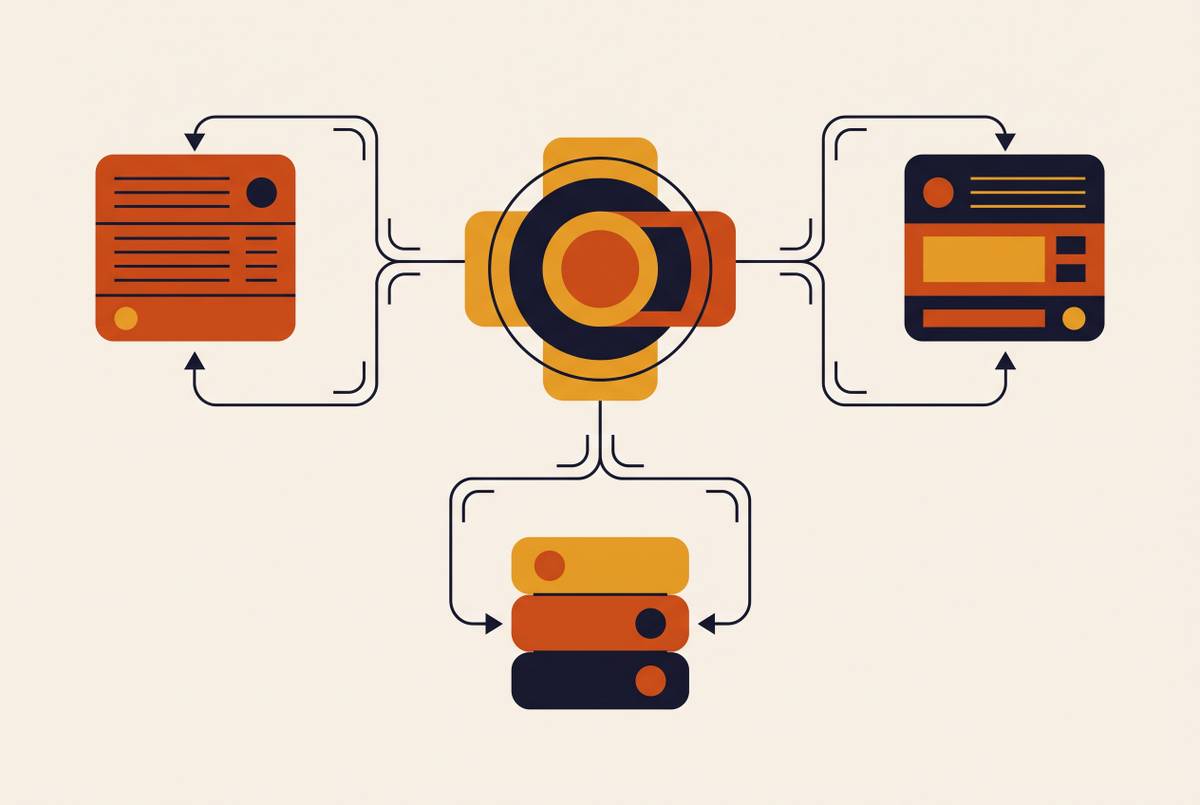
An LLM proxy layer is a reverse proxy built for model APIs. Applications send every request to one stable endpoint, and behind it the proxy picks the provider, handles authentication, and enforces policy. The application never learns which provider answered, and it does not need to.
The request path looks like this: application → gateway → [OpenAI / Anthropic / Google / others]. You call the proxy endpoint instead of a provider SDK, and that endpoint speaks a unified API format the application already understands.
The industry uses three terms, proxy, gateway, and router, loosely, and they mean distinct things. An LLM proxy forwards requests to one or more providers behind a unified API: its job is translation and forwarding, nothing more. An LLM gateway combines both of those functions and adds identity, budgets, rate limits, guardrails, audit trails, and observability on top: its job is control over all AI traffic, not just the forwarding of it.
This article covers gateway-scope functionality, because forwarding and routing alone don't answer the questions that matter once a system is in production: who spent what, and what happens when a provider goes down for an hour. Because all traffic flows through one point, every cross-cutting concern, cost, security, reliability, can be enforced once at that point instead of being scattered unevenly across a dozen services.
Unified API compatibility makes the provider switch a configuration change
The whole argument works because changing the model behind that endpoint requires no change to the calling application.
Picture the before and after. After a gateway is in place, that same switch is an alias reassignment in a config file.
In practice, the application calls /v1/chat/completions with a model alias, something like "model": "production-chat". The gateway resolves that alias to Claude Sonnet, GPT-4, or Gemini 2.5 Flash based on whatever configuration is active at that moment, and the application has no awareness that the resolution even happened. The five responsibilities that define a production gateway, unified access, caching, routing, resilience, and governance, are each enforced once at this layer instead of being rebuilt separately inside every application that needs them.
Centralizing credentials so provider keys never appear in application code
Moving provider keys out of application code and into the gateway is probably the single highest-leverage security change a team can make without altering how it actually uses models.
That shift brings concrete benefits. Rotation happens without downtime. This addresses one of the most common security risks in enterprise AI deployments directly: API keys sitting in repositories or copied across dozens of engineers' laptops and notebooks.
Tie this back to the switching friction that opened this article. When provider keys live in the gateway rather than in application config, swapping GPT-4 for Claude doesn't also mean auditing 40 repositories for hardcoded credentials that need to move with it. Role-based access control at the virtual-key level adds one more layer: a key can be restricted to specific models, specific providers, or specific data classifications, so a single control point enforces access policy across the organization's entire AI footprint.
Routing configuration: how to assign requests to GPT-4, Claude, or Gemini without touching application logic
Once you centralize credentials and API format, you can use the gateway to enforce cost, latency, and quality trade-offs as policy, instead of burying them as one-off decisions in application code. Three routing approaches exist, increasing in sophistication, and the right sequence is to start simple and add complexity only when the data justifies it.
Rule-based routing is the right starting point. It matches on request metadata, things like endpoint, prompt length, user tier, or data classification, and assigns each request to a tier accordingly. It needs zero extra infrastructure, and it captures most of the available cost savings with minimal complexity. The overhead for this kind of rule evaluation runs under 1 millisecond, which is negligible against a typical LLM response time of 500 to 2,000 milliseconds.
Semantic similarity routing is the next step up. You match an embedding index of historical prompts against incoming requests, so a new prompt gets routed to whatever tier its nearest neighbors were assigned to. This approach adapts automatically as the prompt distribution drifts over time, something static rules can't do on their own.
Routing gives you one dominant cost lever, and that is the tiered model strategy. Define three or four tiers, cheap and fast, balanced, and frontier, and route each request to the cheapest tier capable of handling it well. The bulk of the savings this produces comes from routing by task complexity, not from switching vendors to chase a lower sticker price.
Caching, fallbacks, and the reliability controls that come along for the ride
Once requests run through the gateway for routing, two more high-value controls become available without any additional architecture: caching that cuts repeated inference spend, and automatic failover that absorbs provider outages without a single line of retry logic in the application. Neither is a separate system to bolt on. Both exist because the gateway already sits on every request.
Standard API caching only returns a hit for a byte-for-byte identical request, which limits its usefulness in practice. Semantic caching matches on intent instead, using vector similarity, so a prompt phrased differently but asking the same thing returns a cached response from a fresh inference call. Because the cache sits centrally at the gateway, a response generated for one microservice can serve any other service asking a semantically equivalent question. One caution applies here: a fixed similarity threshold set too low can return the wrong cached answer through a false-positive match, so the threshold and the invalidation strategy both need deliberate configuration.
Fallback chains work the same way. When a primary provider call fails, a 429 rate limit, a 503 server error, a timeout, the gateway automatically retries against an alternate provider, with no intervention required from application code. Resilience actually requires three distinct fallback categories: general fallbacks for timeouts and 5xx errors, content-policy fallbacks, and context-window fallbacks, each pointing to a different list of providers with different routing logic. A primary call to Claude Sonnet that fails with a 529 or times out should retry automatically against GPT-4o or Gemini 2.5 Pro in under 200 milliseconds. If a provider outage lasts an hour and you have no gateway, an application calling provider SDKs directly returns a 503 to every user for that whole hour. With a gateway in place, the fallback chain absorbs that outage invisibly, and most users never know it happened.
Token budget enforcement rides along with all of this. Gateways enforce limits on token consumption, because that is the actual unit providers bill against. Per-key, per-team, per-project, and global hard limits mean an overspend gets rejected at the gateway the moment it happens, instead of appearing as a surprise on an invoice three weeks later.
Data security and spend visibility that the proxy layer enforces uniformly
The gateway's position between every application and every provider makes it the only place in the stack where PII redaction, audit logging, and cost attribution can be enforced the same way everywhere, rather than implemented inconsistently service by service.
Redaction logic that lives inside each individual application tends to drift. A new microservice skips it. A contractor leaves it out. Nobody has a unified record proving it ran consistently. At the gateway, you cover every request from every service to every provider with one policy. A production redaction pipeline typically layers four techniques: regex-first pattern matching, contextual heuristics, entity recognition for high-value data types, and asynchronous OCR for images. The gateway detects PII in the prompt, redacts it, forwards the cleaned prompt to the provider, and restores the original values in the response that comes back.
One distinction matters here. Provider enterprise tiers, including zero-data-retention agreements, do not redact PII from prompts before processing, by design, because the model needs the actual prompt text to generate an answer. Customer PII, PCI, and PHI should never reach a model provider unguarded, and any redaction applied should be reviewable and enforceable through a centralized audit record, not scattered notes in individual services.
The audit log itself needs careful design. It has to record enough detail to reconstruct what happened, without becoming a sensitive-data store in its own right. That means logging the data category that was detected and redacted, the guardrail event, the model used, the team responsible, and the trace ID, never the raw prompt and never the PII itself. The redactions and the decision lineage become the compliance evidence, keeping PII out of the log from the start.
Spend visibility follows the same logic. Every request through the gateway gets logged with structured metadata: which team sent it, which model answered, how many input and output tokens were consumed, cost in dollars, latency, and which fallback, if any, fired. Mandating metadata tags, feature name, environment, user ID, on every request gives this visibility structure, and the gateway can enforce that tagging automatically instead of leaving it to individual developers to remember.
Evaluating a self-hosted proxy versus a managed gateway
The choice between self-hosting a proxy and adopting a managed gateway comes down to data residency requirements and operational capacity more than it comes down to any single feature list. The right answer differs by team size and compliance posture, so both paths can be legitimate.
If you self-host, something like LiteLLM Proxy, you shift the operational burden onto your engineering team. If your workload faces data residency requirements, self-hosting can be the only compliant option, and that's a legitimate reason to choose it. Cost savings often disappear once the full engineering hours get counted against them, so the honest comparison runs managed-layer fees against token spend plus the full engineering time for setup, maintenance, and incident response, rather than assuming self-hosting is automatically cheaper.
A managed gateway should not stack a per-token platform fee on top of provider pricing, because that kind of overhead erodes AI return on investment as usage scales. It should also give teams full transparency and intentional control over where requests get routed, so you never get opaque automatic model swapping behind the scenes. For fast-growing teams where AI usage outpaces internal governance, a managed gateway scales controls, team workspaces, SSO, RBAC, budgets, without requiring the team to rebuild infrastructure each time a new provider or use case appears.
Six criteria decide this well in practice. Gateway overhead under sustained load affects throughput and latency at scale, so ask any vendor for a published figure tied to a specific instance type and request rate, not a vague yes or no. Failover behavior matters: how many retries per provider, whether fallback chains exist, whether applications still need their own retry code. Governance depth matters: how many budget levels, virtual keys, RBAC, and SSO are supported, and which pricing tier gates them. On latency specifically, sub-10ms p95 overhead on time-to-first-token is the standard worth verifying, since higher overhead compounds across multi-step agentic workflows where several calls chain together. Security and compliance controls, SOC 2, HIPAA, GDPR-relevant features, should be available to teams of any size from day one, not held back behind an enterprise sales negotiation.
The sequence for wiring a proxy layer into an existing application
You can set up an LLM proxy layer with a repeatable sequence, and the steps hold whether you are migrating off a single-provider SDK setup or building the routing layer from scratch.
Step one points the application at the gateway endpoint. The provider base URL in application config gets replaced with the gateway's OpenAI-compatible endpoint. No SDK changes, no import changes, only the base URL and the API key, now a virtual key issued by the gateway, move.
Step two migrates provider credentials into the gateway. This has to happen before routing configuration, because routing rules need valid provider credentials behind them to actually function.
Step three configures model aliases and routing rules.
Step four sets budget limits and tagging requirements. Per-key and per-team token budgets get configured, and metadata tagging, feature, environment, user ID, gets enforced at the gateway so cost attribution is automatic from day one.
Step five configures fallback chains. For each primary model assignment, a fallback chain gets defined covering general failures, content-policy rejections, and context-window overflows separately, each with its own list of alternate providers.
Step six enables PII redaction and audit logging. The redaction pipeline gets configured for whatever data categories are in scope, customer PII, PHI, PCI, and the audit log gets checked to confirm it records data category, guardrail event, model, team, and trace ID, never raw prompt content.
After these six steps are in place, switching from GPT-4 to Claude or Gemini comes down to an alias reassignment back in step three. What used to mean touching imports, auth, request formats, and error handling in every calling service now just means you change one line in one config file.