API Key Lifecycle Management for LLM Gateway Teams
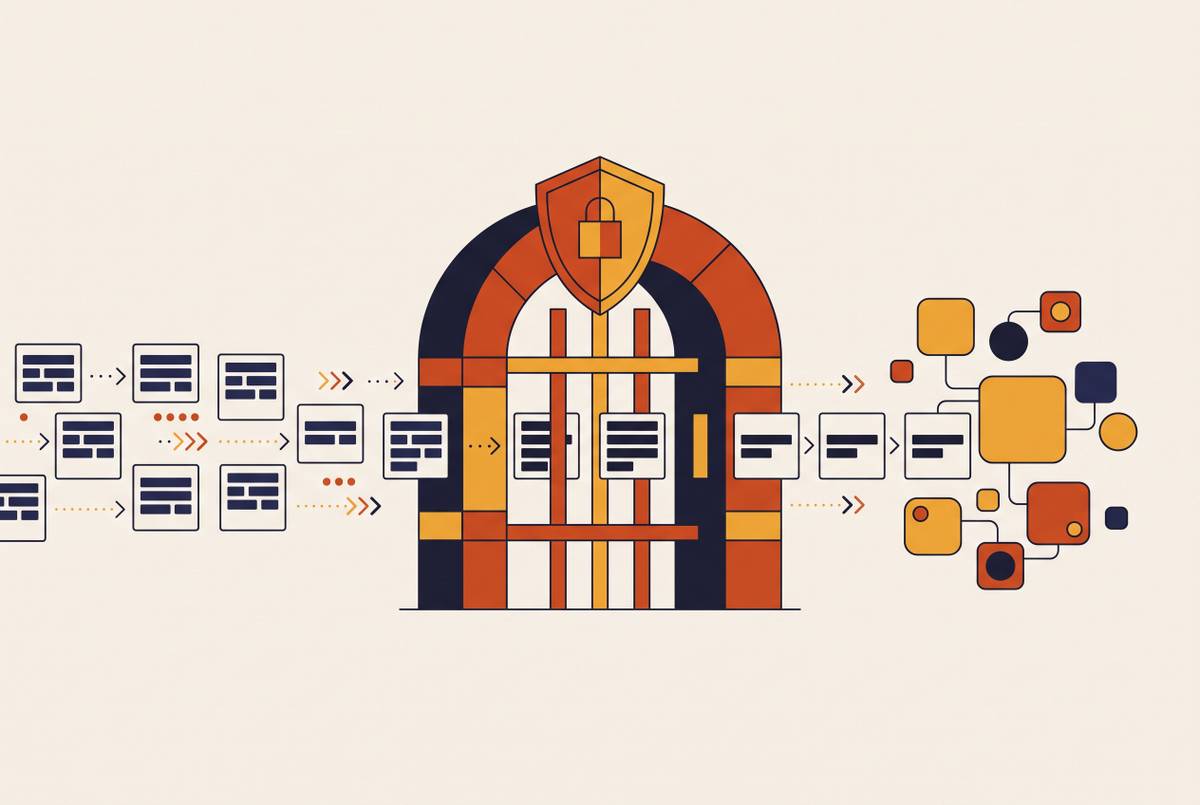
Centralizing API keys at a gateway eliminates sprawl and makes rotation invisible to applications.
An audit starts with a simple question: who is calling which model, on whose budget, with whose data. For most teams running production AI, nobody can answer it cleanly. The direct-key model, where each application holds its own provider credentials, breaks down before anyone notices it has broken. Keys get issued one at a time, for one project at a time, and the sprawl that follows is structural rather than accidental. By the time finance asks what a given team spent last quarter, the honest answer is a spreadsheet built from guesses.
Production AI rarely stays on one provider for long. A team might send some workloads to OpenAI, route others to Anthropic, push regulated data through Bedrock, and send high-volume classification work to a cheaper model picked for cost rather than capability. Without a gateway sitting between the applications and the providers, every one of those applications has to understand every one of those provider's APIs, authentication schemes, and rate limits on its own. Multiply that by the number of teams building with AI inside any mid-size organization: the key sprawl has already happened by the time anyone goes looking for it.
The common objection is some version of "we're small, we only use one provider." That holds for a while. But the shift to multiple providers tends to arrive faster than teams plan for, usually driven by a cost problem, a data residency requirement, or a single outage that makes relying on one vendor feel reckless. Retrofitting lifecycle controls onto a credential set that has already sprawled across multiple services is a much harder project than building the gateway first and issuing scoped credentials from day one. Teams that wait end up doing the hard version of this work under pressure, during an incident, instead of the easy version of it ahead of time.
The two credential classes a gateway separates
A gateway's entire value rests on a distinction that sounds small but determines everything downstream: who is calling versus what is being called. A caller key identifies the internal application or tenant making a request to the gateway. A provider key is a separate credential entirely: it's what authenticates the gateway itself to OpenAI, Anthropic, Azure OpenAI, Gemini, Bedrock, or whatever other model endpoint is in use.
If malicious code executes inside that application, the blast radius is the entire provider relationship: every model, every budget, every rate limit tied to that account is now exposed. Keep the two separate, and rotation at the provider layer is invisible to the application layer. Recovery becomes a matter of revoking one scoped credential, not rotating a provider key across every service that happened to depend on it.
Atlan's gateway explainer names centralized API key management as one of the highest-value capabilities a gateway provides, specifically because it produces zero credential exposure in application code and allows instant revocation without touching a single deployment. That is the practical payoff of keeping the two credential classes apart. The gateway holds every provider key centrally, applications interact only with scoped virtual keys, and the blast radius of any single compromise shrinks to the size of one credential's scope rather than an entire provider account.
How virtual keys operationalize the key lifecycle
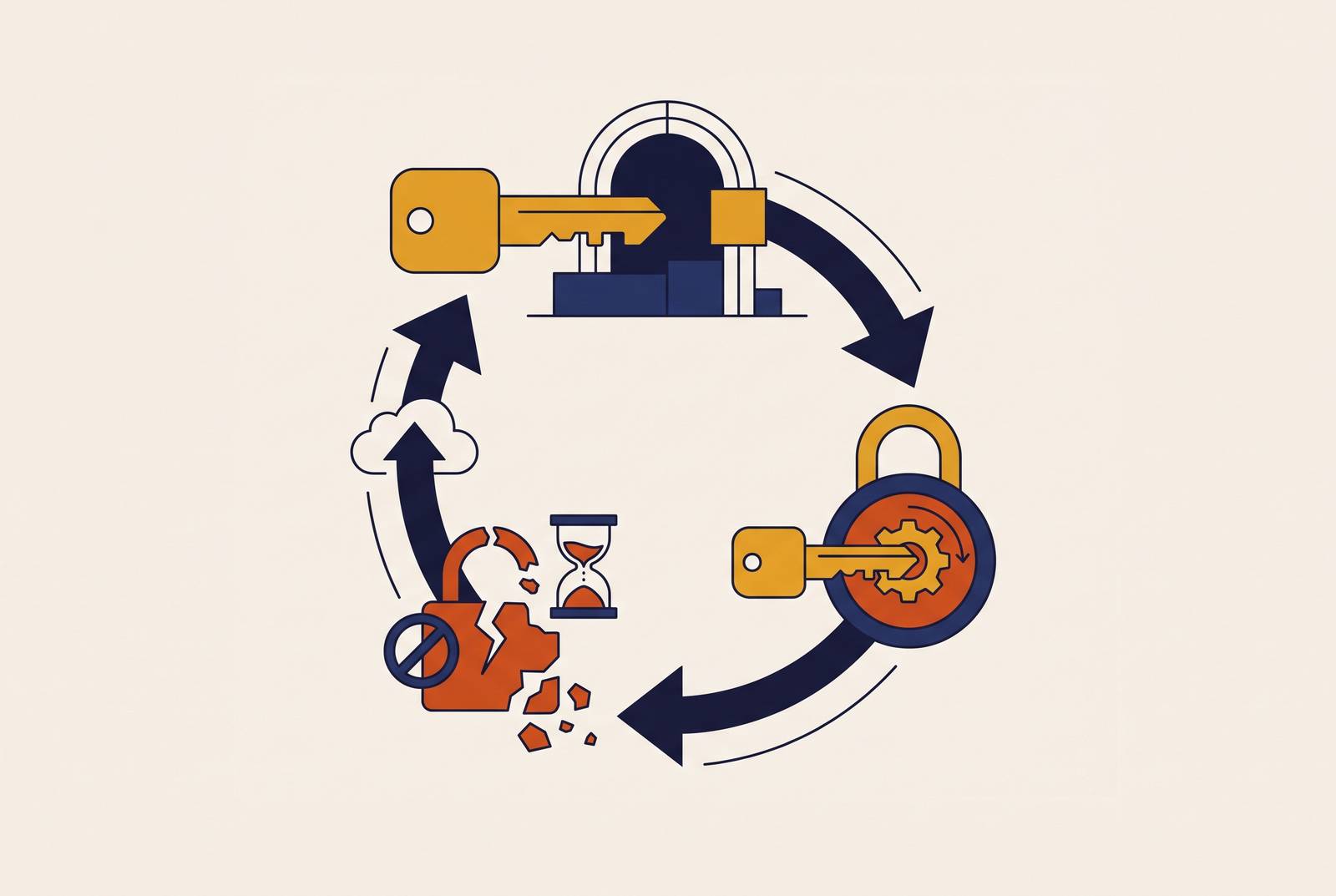
Virtual keys turn the caller-key/provider-key separation into something enforceable, not just conceptually sound. Each phase of the credential lifecycle, issuance, scoping, rotation, and revocation, gets handled at the gateway, without touching application code.
Issuance starts with configuration. A virtual key gets created with a team or project attached to it, along with the models and providers it can reach, a budget ceiling, and rate limits, all set as policy attached directly to the credential. The application receives only that scoped credential. It never sees a provider secret at any point. For anything short-lived, a non-production test or a temporary integration, an expiration window can be set at creation. Once that window passes, the key disables itself automatically, with no manual cleanup required.
Scoping is what gives that key its boundaries. A virtual key can be restricted to specific models, specific providers, specific token budgets, request rate limits, and usage attribution tags, all enforced as policy on the credential rather than logic written into the application. The practical consequence is straightforward: a leaked virtual key exposes only the scope attached to it, not full provider access.
Rotation is where the two-credential-class separation pays off most visibly. Without a gateway, rotating a provider key that's shared across microservices means redeploying every one of them, and missing even one means that service goes dark the moment the old key gets deleted. With a gateway, the provider credential gets updated centrally, and every subsequent request uses the new one automatically. Application code, configuration, and deployments stay completely untouched. Separating the two credential classes means that rotation at the provider layer stays invisible at the application layer.
Revocation closes the loop. A compromised or stale virtual key gets revoked on its own, with no coordinated rotation required across every service that might depend on it. The effect is immediate and narrow: only the scope attached to that one key disappears, not provider access for the rest of the organization. Keys issued to a departing employee, a deprecated service, or a finished project can be retired cleanly, without disrupting live traffic running on every other key.
Attribution and observability a lifecycle layer makes possible
The questions raised at the start, who is calling which model, what each team is spending, which data crossed which boundary, only get answered once every request runs through a single control plane. A gateway that owns the full key lifecycle sits in exactly that position, and it's the only place in the stack positioned to produce attribution that can actually be trusted.
Every call passing through the gateway can carry structured metadata: the scoped key that sent it, the model that handled it, input and output token counts tracked separately, latency, cost in dollars, and any fallback that got triggered along the way. Production-grade gateways expose this through Prometheus and OpenTelemetry, so the data plugs into observability stacks teams already run instead of forcing every application to build its own instrumentation.
That same record gives security what it needs for an audit trail: which identity sent which prompt to which model, when, and with what result. SOC 2 Type II audits favor outcome-based evidence over prescribed log formats, but an audit trail like this satisfies that bar in a way that ad-hoc, per-application logging reliably fails to produce.
The reporting side matters just as much as the audit side. Giving every team a regular breakdown of spend by model, use case, and trend, without necessarily enforcing hard caps, changes behavior on its own. Teams that can see their own footprint next to their peers tend to self-correct before finance has to intervene. Without that visibility, spend accumulates quietly. Ordinary agent activity that nobody instrumented or governed can run up significant cost long before anyone in finance understands what's driving it. A lifecycle layer is what turns that invisible accumulation into a number someone can actually see and act on.
Security obligations the gateway lifecycle layer must itself satisfy
Centralizing every provider key in one place makes the gateway the single most valuable target in the entire stack. A compromised proxy doesn't expose one credential, it exposes all of them simultaneously. Lifecycle management must account for the gateway's own security posture, not just the credentials it hands out.
Provider API keys should never sit in environment variables, configuration files, or container image layers that might reach version control or a container registry. The correct pattern is integration with a dedicated secrets manager, HashiCorp Vault, AWS Secrets Manager, Azure Key Vault, or GCP Secret Manager, the baseline a gateway needs to meet before it can be trusted to hold every provider credential an organization has.
The 2026 vulnerability record for self-hosted gateways makes the stakes concrete. LiteLLM's 2026 GitHub Security Advisories list three vulnerabilities rated Critical, an authentication bypass via host header injection, a SQL injection in proxy API key verification, and an authentication bypass via OIDC userinfo cache key collision, along with five more rated High. A separate supply-chain incident involved published versions that contained credential-harvesting malware. None of this is a knock against any particular project. It's a documented record of the kind of risk that comes with operating a self-hosted gateway, and any team running one needs to account for it directly.
That record carries a real operational cost. An engineering team that would rather be building product now owns patching, hardening, and incident response for the one system that holds every provider credential the organization has. The regulatory environment is tightening around exactly this kind of exposure, too. The EU AI Act's enforcement framework, covering transparency duties and enforcement powers, applies from August 2, 2026, after phased rollout starting in 2025. For teams operating in scope, audit-trail and PII-redaction requirements have moved from best practice to mandate. A team can audit its self-hosted gateway rigorously and still be left asking whether that ongoing burden, patching critical vulnerabilities, maintaining compliance evidence, hardening a high-value target, is the best use of its engineering capacity compared to a managed alternative built to carry that weight.
Scaling the Lifecycle Layer with Team and Provider Growth
The direct-key model forces a rebuild every time something changes: a new provider, a new team, a new compliance requirement. A gateway built around lifecycle management is designed to absorb all three without touching application code or restructuring how credentials work.
Adding a new provider means adding a credential centrally at the gateway. Applications keep calling the same internal endpoint with the same scoped virtual keys they already had, with zero changes required on their end. Adding a new team works the same way in reverse: a new virtual key gets issued with its own budget, model access, and attribution tags, and that team is productive immediately, without needing direct access to any provider account or a separate onboarding process built from scratch. Workspace-level isolation lets teams operate independently inside a shared gateway, without visibility into each other's keys, budgets, or logs, which matters for organizations where different business units carry different compliance obligations or sit on different cost centers.
The lifecycle layer also becomes the foundation for routing decisions that have nothing to do with credentials on the surface but depend on them underneath. Cost varies widely across models, so a gateway can route judgment-heavy calls to frontier models and bulk classification work to smaller, cheaper ones, applying semantic caching for prompts that repeat in substance if not in exact wording. All of that routing logic runs on top of the same key and policy infrastructure that handles issuance, scoping, and revocation, making it operational intelligence built on a credential system rather than a separate feature bolted on beside it.
Agentic workflows raise the stakes further. A single user request can now trigger multiple model calls across several providers, MCP servers, and tool calls strung together in sequence. Every hop in that chain needs to be authenticated, attributed, and logged through the same control plane, which makes the lifecycle layer more critical as orchestration grows, not less. Agentic deployment has become the fastest-growing pattern for enterprise AI in 2026, even though production adoption so far is concentrated among early movers, and a gateway lifecycle layer built only for simple, single-turn completions will not hold up as that orchestration complexity spreads. Fallback chains must inherit the same constraints: when a primary provider goes down and a request reroutes to an alternate, that alternate path has to inherit the same data privacy constraints and scoped access rules as the primary route. A request shouldn't fall back to whatever endpoint happens to be available. The lifecycle layer is what enforces that the fallback obeys the same rules the original call did.
What to look for in a gateway built for lifecycle management
Teams that treat lifecycle management as a first-class requirement end up asking different questions than teams shopping purely on provider breadth or raw throughput, and those questions are worth having in hand before any evaluation starts. The first set concerns the virtual key architecture itself: does the gateway issue genuinely scoped credentials, with per-key budgets, model restrictions, rate limits, and expiration built in, or does it simply proxy requests through to providers without enforcing any of that at the credential level. Revocation deserves a direct test, too: a key should be revocable instantly, with no need to touch any application deployment to make that revocation take effect, and provider credential rotation should be something application code never has to know happened.
Attribution and observability make up the second set of questions. A gateway worth building a lifecycle program around should produce structured, per-request logs covering identity, model, provider, separate input and output token counts, cost, and latency, rather than a reconstruction assembled after the fact from billing exports. Spend visibility should be real-time and granular, broken down by team, project, key, model, and provider, so finance and security can both pull the same underlying data to answer very different questions. The gateway's own security posture belongs in this evaluation as well: how provider credentials are stored, whether secrets manager integration is native or bolted on, and what the vendor's track record looks like on patching and disclosure. A gateway that centralizes every provider key in an organization is only a genuine improvement over the sprawl it replaces if it can defend that centralization with the same rigor it asks of everyone else, which is the standard Concentrate AI, a fully managed AI gateway that strips PII and PHI from requests before they leave its control plane and reach any model provider, holds itself to.