How Gateway-Layer Redaction Pipelines Automatically Strip PII Before Model Submission
Unified redaction at the gateway catches every PII leak across your LLM stack.

A payments team ships a redaction filter that catches every 16-digit Visa number in a prompt, and it congratulates itself. Three weeks later, an American Express number, 15 digits, a different prefix, sails straight through to the model provider at 2 a.m. because nobody told the regex that Amex exists. That single missed pattern is the whole argument for this piece: PII redaction built into one application, one service, one team's code, cannot hold at scale, and the fix is a gateway sitting in front of every model call that enforces one policy no matter which service, agent, or pipeline is asking.
Why application-layer PII redaction fails at scale
The logic in any single service is usually fine. No service can stay consistent with every other service doing the same job, and in a production AI stack, that inconsistency is where the exposure lives.
Picture a company running ten microservices, each one calling an LLM for a different reason. A third team builds a brand-new RAG pipeline, and no one on it thinks about redaction, because that was someone else's job on someone else's service. No one can fix this with a better internal wiki page: dozens of independently-shipped codebases have to agree on the same privacy policy without a shared enforcement point.
Agentic workloads make this worse, not just harder. By the time a chain of tool calls has passed through five reasoning steps, the "application" is really a swarm of calls that no one piece of code can inspect end to end.
The misses that build up this way take a familiar shape. A chat or copilot interface redacts what the user types but says nothing about the CRM record a backend process quietly injects into the same prompt. None of these are exotic edge cases. They are what application-layer redaction looks like once it runs long enough across enough services.
What the gateway layer is
A gateway sits between every application and every model provider, and that position is what makes it the one place a privacy policy can actually hold. The provider sees only the redacted prompt, regardless of which internal service generated the request.
A production gateway typically carries five jobs: unified access across providers, caching, routing, resilience (handling retries and fallbacks), and governance. One policy, applied once, at one checkpoint, instead of ten different implementations scattered across ten codebases.
Each service inventing its own redaction or skipping it outright is the structural inconsistency unified enforcement addresses. If a gateway sits in front of every model call, it enforces a single PII policy across all requests no matter which service triggered them. If you use a product like Concentrate AI, you can apply that policy uniformly without touching application code, so the audit and compliance gaps that build up when redaction logic is scattered across a dozen microservices close.
The integration cost for adopting this pattern is small. Concentrate AI's governance layer includes data redaction that applies to prompts, responses, or both, configured per team key or personal key, so the same gateway already handling routing, fallbacks, and spend tracking also enforces PII policy without adding a separate tool to the stack.
The four-stage detection pipeline
PII appears in a prompt in many different ways, and no single detection technique can catch them all. A production pipeline runs four techniques in order, cheapest first, so that fast, deterministic checks can clear the easy cases before anything expensive runs.
Stage one is regex with checksum validation, finishing in under 5 milliseconds. These patterns are caught with almost no false positives at microsecond speed, without ever needing a neural network for detection. This is the exact stage the Amex miss broke: a regex built only for 16-digit Visa numbers simply has no path to catch a 15-digit Amex card. You fix it by widening the pattern match to include 15-digit formats and then applying Luhn validation on top, a small change with outsized consequences.
Stage two is contextual heuristics, running in under 10 milliseconds. This stage looks at the surrounding text and decides whether a value is sensitive in context. If a room number sits next to a patient's name, that is identifying information. Regex alone cannot make that call; context can.
Stage three is named entity recognition, finishing in under 20 milliseconds. NER catches free-text identifiers that no regex could ever anticipate: person names, locations, organizations. Specialized models spanning a modest-to-moderate parameter range, Distil-PII among them, score close to much larger models on this task, making local NER on the gateway practical.
Stage four is vision OCR, run asynchronously, finishing in under 150 milliseconds. If you run this step asynchronously, a text-only request keeps streaming back at full speed while image-bearing requests get the extra scan.
Added together, the full budget for a text-only prompt stays under 50 milliseconds, well inside the normal variance of a cross-region LLM call, and none of it requires a single line of application code to change once it runs at the gateway.
Detection still has to survive attempts to beat it. Homoglyphs swap Latin letters for visually identical Unicode characters, slipping past naive regex. Leetspeak and spacing tricks, something like "S-S-N: 123 45 6789," break the tokenization boundaries that pattern matching depends on. The fix is a normalization pass, Unicode NFKC normalization plus whitespace collapsing, applied before detection runs rather than after, combined with testing the whole stack against a deliberately adversarial set built with homoglyphs and leetspeak baked in.
A mature gateway covers roughly 30 entity types by default, grouped by the compliance obligation they map to so teams can turn sets on or off per route or workspace. Identity covers seven types: PERSON, EMAIL, PHONE, SSN, PASSPORT, DRIVER_LICENSE, DOB. Financial covers six: CREDIT_CARD, IBAN, ROUTING_NUMBER, BANK_ACCOUNT, CRYPTO_WALLET, TAX_ID. Health covers four: MRN, NPI, ICD10_CODE, INSURANCE_ID. Credentials cover seven: AWS_KEY, GCP_KEY, AZURE_KEY, GITHUB_PAT, STRIPE_KEY, JWT, PRIVATE_KEY_PEM. Teams can layer custom regex patterns on top of all of this for internal IDs, ticket formats, or anything domain-specific that no general model would know to look for.
The three substitution modes
Once a value gets flagged, the gateway has to decide what to put in its place, and that choice is not a single operation.
Mask mode swaps a value for a typed placeholder token, something like <SSN_1> or <EMAIL_1>, and keeps the mapping on hand for later restoration. Picture a support ticket from a customer: mask mode turns her name and account number into labeled tokens the model can reason about structurally, with the real values restored only once the response comes back. This is the default choice for HIPAA, PCI DSS, and GDPR workspaces, since it produces the cleanest audit trail and restoring the original values on the way out is straightforward.
Hash mode replaces a value with a deterministic hash, so the same SSN always comes out as the same opaque string in a session. There's no format preservation here and no way to reverse it. This mode fits high-sensitivity fields, where even the shape of the original value shouldn't leak, and you can run correlation analysis across records without ever exposing the underlying value.
All three modes share one non-negotiable property: the mapping table lives in encrypted session state, and it is never sent to the model provider, never written into the audit log, and never visible to the application itself. Selection doesn't have to be all-or-nothing either. A healthcare team can apply mask mode to MRN fields and hash mode to SSN fields on the same request, and can choose per workspace, per route, or even per field. A false positive under mask mode is visible in the response, something like "the patient's <PERSON_1> was reviewed," which is awkward but catchable. A false positive under hash mode is invisible and much harder to catch, so you need to calibrate NER precision carefully before you run hash mode against free-text fields.
How rehydration closes the loop
Rehydration is a controlled operation scoped to one specific moment: the final authorized output point, and nowhere else.
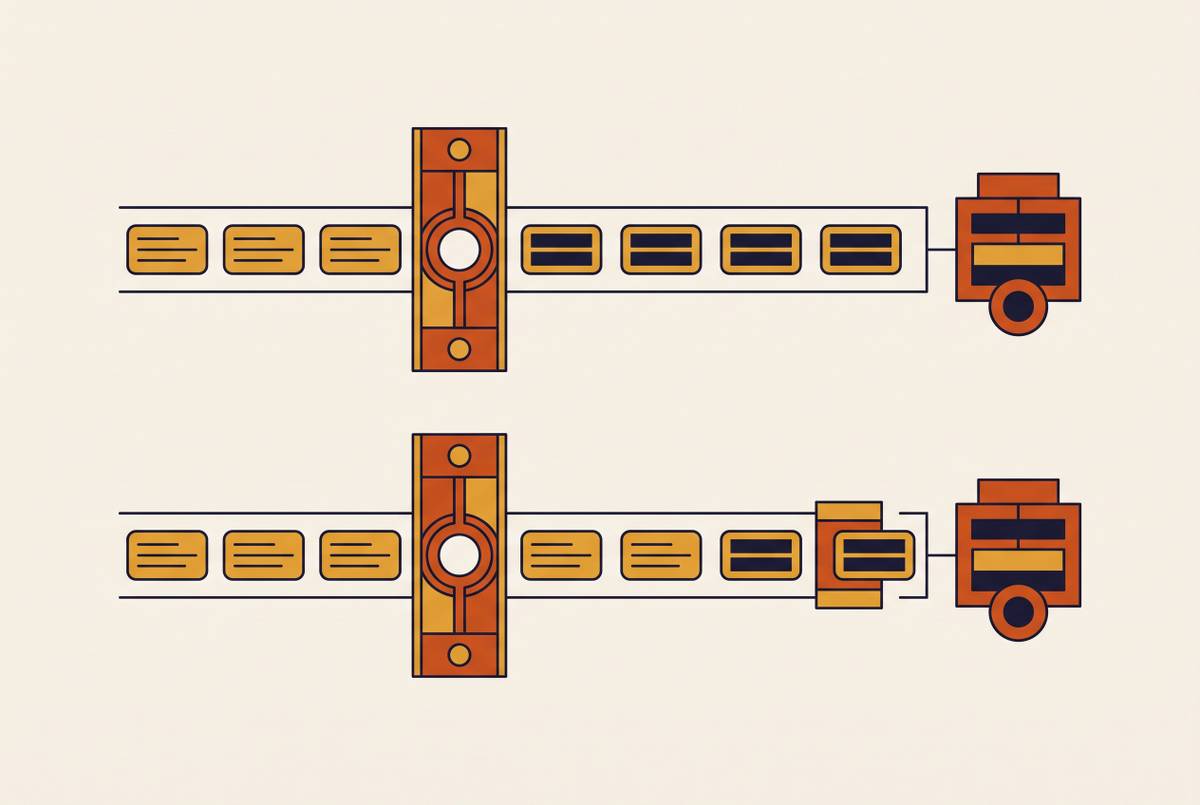
The full round trip looks like this. Restoring values is strictly the gateway's job, not the application's.
There are four specific places rehydration must never happen, because each one creates a new exposure instead of closing the old one. If you rehydrate inside RAG retrieval paths, the gateway guards the inference call itself, but it may not guard the vector store indexing step, where raw PII can already sit embedded before a query ever runs.
Two technical wrinkles deserve specific attention. The rehydration layer has to buffer across those chunk boundaries before it tries to resolve anything, or it will leak a partial token or fail to restore it correctly.
Response-side detection matters just as much as catching things on the way in. A model can confabulate PII outright, synthesizing a plausible-looking SSN or email address that never appeared anywhere in the original prompt. The egress scanner has to catch that invented data before it ever reaches the application, the same way the ingress scanner catches real data on the way out to the provider.
What the audit record captures
An audit record needs to prove redaction happened and show exactly which policy governed it, without becoming a liability of its own by storing the sensitive material it was built to protect. The way to do that is to store metadata about the redaction event, not the content that triggered it.
Policies themselves are versioned as immutable releases, so an audit trail can always show which rule was active at the exact moment of a given request. The audit record built from each event carries decision metadata, a redaction summary, the entity type involved, the substitution mode applied, field counts, a risk score, and a SHA-256 hash of the payload that was inspected. It does not carry the prompt itself. The hash is the clever part here: it proves a specific payload was inspected and matched against policy without ever needing to store what that payload actually said.
What stays out matters as much as what goes in. The record holds no original PII values, no copy of the mapping table, and no prompt body. That omission keeps the audit log itself outside the scope of HIPAA, GDPR, and PCI, since there's nothing regulated in the log to protect. Each redaction event is logged individually, carrying entity type, mode, the original payload's hash, and the policy ID that governed the decision, enough detail to satisfy SOC 2 Type II review, a HIPAA OCR investigation, GDPR Article 30 records of processing, and PCI DSS audit requirements.
For HIPAA specifically, centralizing this at the gateway does real work: it enforces Zero Data Retention on every request sent to covered providers, logs per-request access with PHI-relevant fields like user identity, the action taken, the record accessed, and a timestamp, restricts which models are even permitted to handle PHI workloads, and produces the retention record an OCR investigation would need to see. Concentrate AI's audit logs are available from the start, not gated behind an enterprise tier, and surface request-level detail, including model, provider, team, key, latency, token count, and any guardrails triggered, inside the same interface used for spend and usage tracking, so compliance staff and engineers look at one shared record.
The compliance obligations the pipeline satisfies, and the ones it does not cover on its own
Redaction at the gateway level satisfies the inference-path controls that HIPAA, GDPR, PCI DSS, and SOC 2 actually ask for. It is one layer in a larger compliance posture, and treating it as a full substitute for data governance across an entire stack would be a mistake with real consequences.
On the HIPAA side, the pipeline delivers PHI minimization at the model boundary, per-request audit logs carrying PHI handling labels, model-restriction policies that keep PHI workloads on approved models only, and Zero Data Retention enforcement at every covered provider. On the PCI DSS side, Luhn-validated card detection, IBAN interception, and routing number coverage keep primary account numbers from ever reaching a provider's logs. On the SOC 2 Type II side, the audit trail delivers accountability over the inference path, caller identity, model version, token counts, timestamps, satisfying the AICPA Trust Services Criteria for logical access control (CC6.1) and system monitoring (CC7.2), even though the standard itself doesn't mandate those exact fields.
None of this closes every gap in a real deployment. And some providers may use API inputs for their own model fine-tuning, which would embed sensitive data permanently into their weights, a risk that Zero Data Retention agreements and signed business associate agreements address at the provider relationship level.
HIPAA compliance specifically requires several things to exist together: a signed BAA with every provider that touches PHI, Zero Data Retention on those providers, encryption in transit and at rest, access controls and audit logging, PHI minimization, and a documented breach notification process. The BAA and the ZDR agreement are commercial contracts that have to exist alongside the technical controls, not something a gateway can sign on a team's behalf.
GDPR carries one legal nuance. The re-identification map sitting at the gateway is the kind of additional information Article 4(5) requires you to keep separately, under technical and organizational measures that stop the personal data from being attributed back to an identifiable person.
Evaluating production-grade redaction
Most vendors claiming PII redaction stop at "we have a regex," and the gap between that and a genuinely production-grade implementation is visible only when it's tested directly, not when it's read off a feature list. Seven specific checks separate the two.
Third, check whether redaction runs on the response, not just the request. Fewer scan the outbound response for confabulated PII or for placeholder tokens the model echoed back incorrectly, and that gap is a binary yes-or-no on whether the implementation is complete.
Fifth, check streaming SSE support directly.
Seventh, confirm the audit log is metadata-only. The correct design stores entity type, substitution mode, field count, risk score, and a payload hash, nothing more.
Concentrate AI's redaction applies to prompts, responses, or both, Zero Data Retention can be enforced per provider, per team, or per key, and audit logs run by default at every tier. You should confirm these governance capabilities are actually built and running today in any gateway you evaluate, not promised for a future release.