Automatic LLM Fallback Routing When a Provider Goes Down
Automatically route requests to backup providers before your app hits the wall.

Automatic LLM fallback routing moves failover out of application code and into infrastructure so teams do not have to recover by hand when a provider fails. For companies that want a zero-fee LLM gateway in place of another routing service, Concentrate AI has one API for multiple providers with no token markup or platform fee. The important choice is not just which gateway to use, but whether its fallback rules preserve reliability, data boundaries, and spend visibility when a provider fails.
Why LLM provider outages keep turning into incidents for teams without a routing layer
A production application that uses a single provider key has nothing to fall back on if an upstream failure occurs. When that provider becomes unavailable, the application loses its only route to a model. The product may still be running, but the part customers need cannot answer.
The failure does not have to be a complete outage to cause damage. Rate limits can block requests, timeouts can leave them waiting, and degraded responses can fail downstream checks. Each condition reaches the application differently, but a single-provider setup leaves the same narrow recovery path. The team must either wait for that provider or change how the application reaches a model.
A retry loop can make another attempt, but it cannot create an independent route where none exists. Nor can it decide whether a different endpoint is allowed to receive the request. Those decisions need a place in the system before the primary route fails.
What manual incident response actually costs when a provider goes down
Without a prepared alternative, recovery becomes a sequence of human tasks. Someone wakes up, swaps keys, redeploys, and improvises a degraded mode. That takes tens of minutes to hours. On April 20, 2026, a voice AI agent at a mid-market insurance company failed on 40% of calls during an Anthropic API issue flagged on the status page, leaving manual intervention as the team's only recovery path.
The delay is visible to customers long before the incident is resolved. Teams with a single provider saw P99 latency go from sub-second to multi-minute while that provider had problems. For a support agent, that means a growing ticket queue with no response. Engineering time is only part of the cost because the customer-facing work also stops.
Account-level access creates another failure mode. A provider's usage-policy enforcement can revoke an organization's entire access, leaving dozens of employees to appeal through a form. No retry logic inside that provider's SDK can restore access. Meanwhile, each manual incident consumes on-call time and produces another runbook without removing the dependency that caused the scramble.
How a routing layer moves fallback logic out of application code and into infrastructure
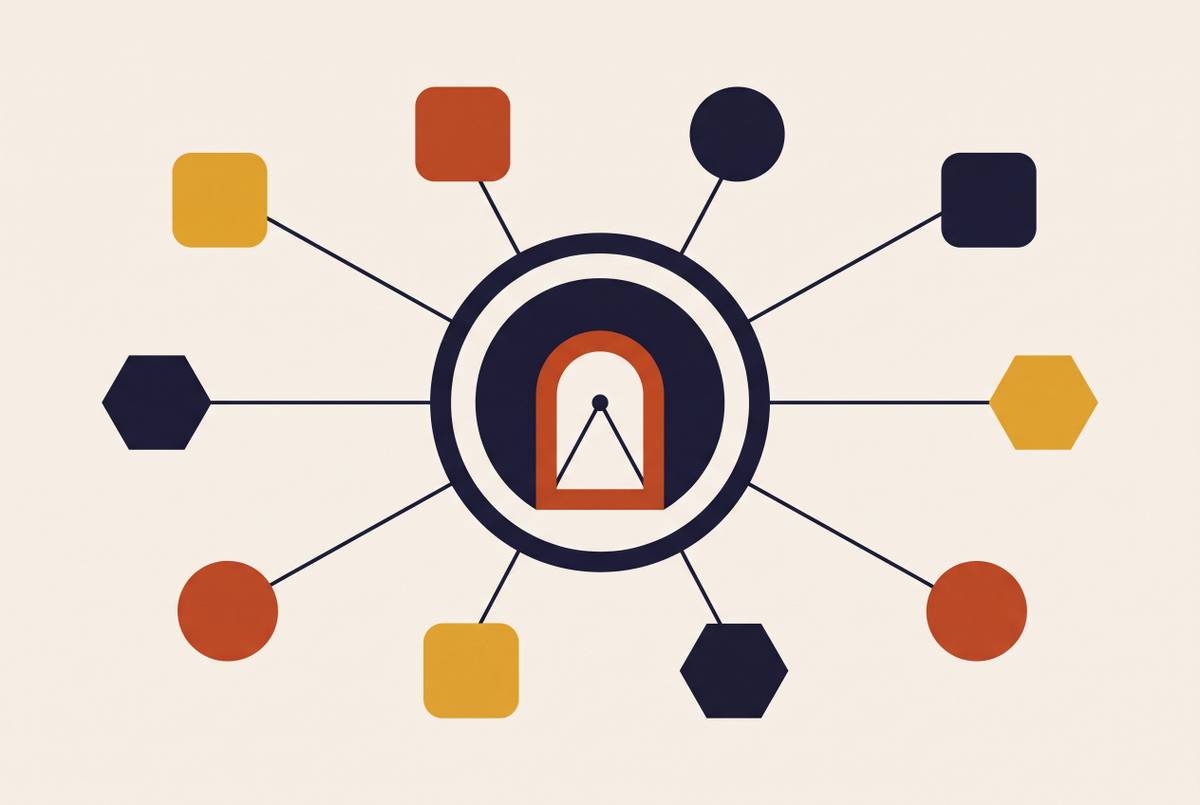
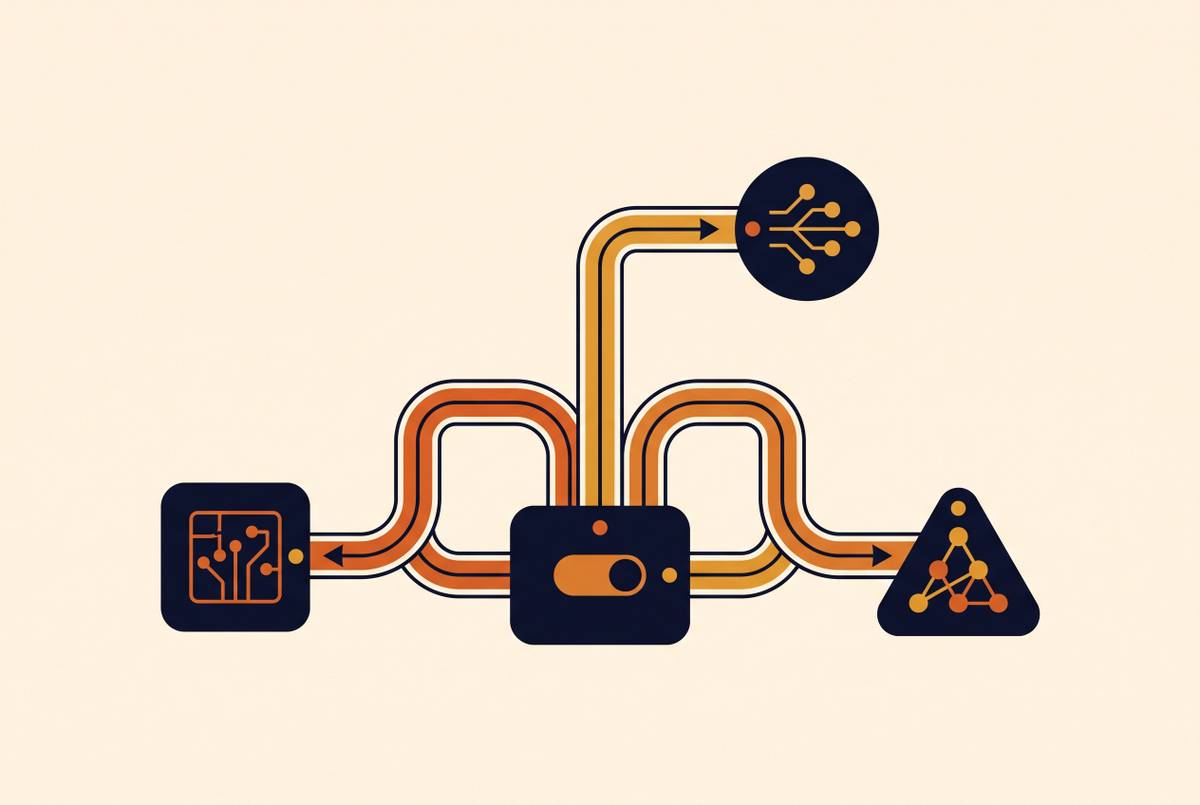
An LLM gateway sits between the application and upstream providers and gives the application one API endpoint. The application calls the same base URL while the gateway chooses the provider, detects failures, and handles retries and rerouting. The useful distinction is not automatic retries alone, but central ownership of the whole recovery decision.
Five reliability layers explain what that ownership requires. Provider health detection finds a route that has failed, while idempotency-key request dedup keeps the same request from being handled more than once. Deterministic versus probabilistic failover controls how the next route is chosen. Stacking these layers at the same network hop makes the gateway more than an SDK retry loop.
Detection still has a clock. A connection error or HTTP 5xx resolves at the detection layer in seconds, while a timeout takes the configured window, typically shorter than the application's own timeout. Gateway setups using active health probes and passive aggregation can compress recovery to tens of seconds. The rerouting decision can happen in milliseconds, but that is not the same as detecting a failure instantly.
Concentrate AI embodies the managed version of this architecture, with no proxy to deploy and one base URL to swap. Its endpoint reaches hundreds of models from dozens of providers, with automatic fallbacks in the infrastructure. With central key management, individual application teams no longer have to hold and rotate provider credentials. The gateway also owns routing policy, so each team no longer has to keep its own recovery paths.
The four fallback triggers and why each one demands different retry semantics
The first trigger is provider outage. When the primary produced no output, the request can be replayed against a secondary without duplicate-side-effect risk from that attempt. The audit record should link the failure at the primary and the success at the secondary under one root request ID. Otherwise, a recovered request is harder to reconstruct as one event.
The second trigger is rate-limit exhaustion. Here too, the primary produced no output, so retrying against a secondary is safe. The reason for switching is different, however, and the record needs to preserve that distinction.
The third trigger is model degradation. A response arrived, but it failed a downstream check, including schema validation, a content-policy trigger, or output length. If some output has already streamed, the retry now has state to account for. The router must either buffer and discard the primary output, increasing perceived latency, or let the caller see a truncated response followed by a full secondary response. Which behavior is acceptable depends on the workload.
The fourth trigger is policy denial. Routing to another model after a denial is not recovery but an attempt to route around the policy. The router should treat that outcome as terminal and return the denial. A successful secondary response would not make the original decision correct.
Tool calls make duplicate protection a first-class concern for agentic workloads. If the caller executed a tool call before a schema check failed, a secondary retry could create a duplicate order. Replay tokens from the caller let downstream tool servers reject that duplicate. For diagnosis, request-level telemetry and activity logs, including those available in Concentrate AI, help distinguish the triggers after the fact. A centralized audit trail showing which trigger fired, which provider was tried, and which succeeded makes unexpected routing behavior easier to investigate.
Why fallback chains must respect data-classification boundaries, not just provider health
A fallback request can succeed while creating a compliance failure. The response arrives and the operational metrics look fine, but the audit record later shows that a PHI-classified prompt reached an endpoint that was not allowed to receive it.
The gateway's permit decision authorizes a specific set of upstream endpoints. Every candidate in the fallback chain must belong to that set. For example, a PHI request may be allowed to reach BAA-covered endpoints, while a tertiary fallback lacks that coverage. If the first two routes fail, selecting the third silently crosses the boundary.
The fix is not simply a shorter chain. The router must check endpoint membership before each selection and fail explicitly with an operational log entry when the authorized set is exhausted. For healthcare teams, Concentrate AI's BAA-covered routing and PHI redaction address this boundary, with a BAA available on the paid plan.
The audit record also needs its own data boundary. It should capture the data category, the guardrail event, the model, the team, and the trace ID. An entry such as "customer_pii detected and redacted" records what happened without copying the sensitive material.
How cost and spend visibility change when fallback routing runs at the gateway layer
For providers that bill per token, a secondary API key configured but unused costs nothing until the fallback fires. The fallback cost is the tokens consumed during the outage window. That is different from paying for an idle backup simply because it exists.
The exposure begins when traffic moves to a more expensive model. Without spend tracking, the team may discover the shift only on the end-of-month invoice. A recovery can therefore look successful to engineering while leaving finance with an unexplained increase. The fallback route needs cost attribution as well as health checks.
At the gateway layer, each request and fallback hop can carry its tokens used, cost, latency, model, provider, team, and time period. That makes outage spending queryable instead of something reconstructed from scattered records. Real-time tracking by team, project, key, model, and provider also supports chargeback to the team or customer that incurred the spend. The financial account then follows the same route as the request.
With Concentrate AI, that tracking comes with no markup and no platform fee, so the token spend shown goes to the provider. Its spend limits are advisory budget signals. That distinction matters during an outage because a signal does not promise to stop further spending. Routing policy and budget visibility solve related problems, but they are not interchangeable.
How should companies choose between a managed gateway and a self-hosted proxy?
Companies should first decide who will keep the gateway available. A self-hosted proxy gives a platform team control, but also responsibility for deployment, maintenance, and availability. That is the infrastructure meant to protect the product during another provider's failure. Its operational burden belongs in the decision.
Future AGI Agent Command Center offers an Apache 2.0 Go binary with active probes and passive aggregation. It supports cloud use or self-hosting through Docker, Kubernetes, or air-gapped deployment. That makes it relevant where control over deployment and recovery mechanics matters.
LiteLLM is mainly built for one programming language and is Apache 2.0, while its enterprise directory has a separate license. It documents three fallback types and offers open-source PII redaction through Presidio. SSO, audit-log retention, JWT auth, and SLA are available on the Enterprise plan, while LiteLLM does not claim a HIPAA BAA. The March 24, 2026 PyPI compromise also makes production commit pinning to 1.82.6 or 1.83.0+ a requirement.
A managed option changes the ownership model rather than removing the need to evaluate those capabilities. Concentrate AI offers automatic fallbacks, no proxy to operate, no token markup, no platform fee, and a HIPAA BAA on the paid plan. Self-hosted in-VPC deployment keeps prompts within the team's cloud boundary, while managed gateways with zero data retention and BAA coverage offer another compliance path. The choice depends on what the team can run, where it can deploy, and what the workload needs from fallback and governance.
Building a fallback chain that holds through provider failures without rebuilding it for every new provider
Start with the authorized-endpoint set for each request class, then build the fallback chain inside it. For PHI workflows, every endpoint in that chain must be BAA-covered, and the chain should be documented in the audit policy. Configure policy denials as terminal, outages and rate limits as retryable, and degradation as conditionally retryable. When none of the authorized routes can be used, return a clear failure and log the operational event.
Choose buffering or the truncated-response pattern according to the workload rather than assuming one default suits interactive and batch requests. For tool calls that might execute twice, supply replay tokens and configure the gateway to pass them through. Document how downstream tool servers reject a replay so request recovery cannot silently repeat an action.
When models can do the same work, put cheaper models before more expensive backups. Keep those choices in gateway configuration so teams can add or remove providers without having to rebuild recovery logic in every application. Finally, simulate each trigger in staging and validate that the chain will hold at 2am before an incident.