Multi-Tenant AI Infrastructure for SaaS Products
Isolate tenant data and costs at the gateway layer before your infrastructure scales into chaos.
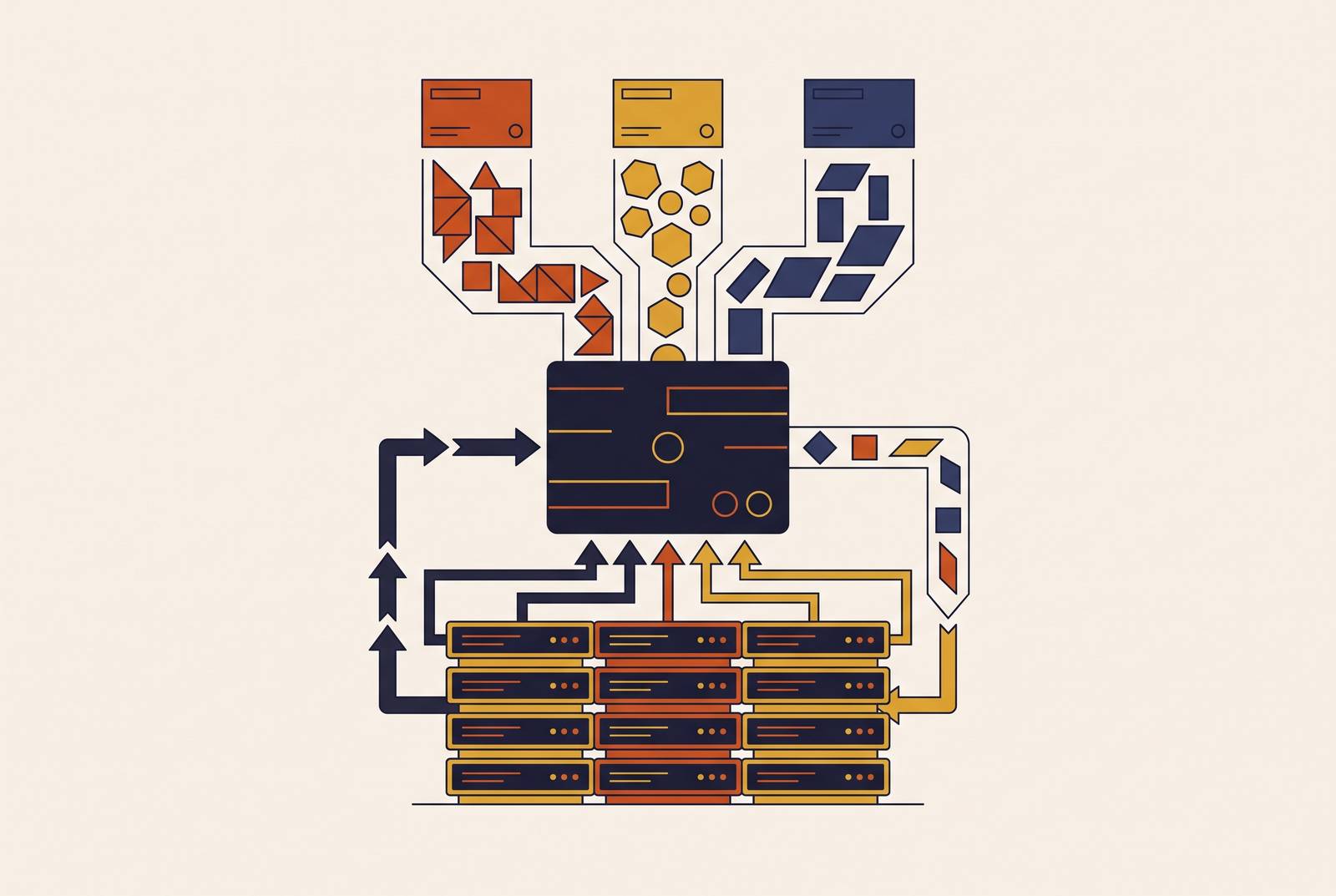
The starting pattern feels reasonable enough that most teams don't question it until it's too late. A shared provider API key, a shared connection to a model endpoint, prompt construction inside feature code with a tenant identifier injected somewhere in the payload. It works in development. It works in a small beta. Then it starts failing in ways that take weeks to diagnose, precisely when you have enough tenants that the failure is expensive and visible to the wrong people.
Here is the structural problem, stated plainly. A single provider API key means every tenant's traffic arrives at the provider under the same identity. No per-tenant audit trail, no per-tenant rate limiting, no way to revoke one tenant's access without pulling the key that serves all of them. That becomes acutely concrete the first time a compliance team asks you to produce a record of every prompt that contained a specific customer's data. If isolation lives in application code, that request requires a significant forensic effort to answer.
Prompt construction in feature code compounds this in a way that doesn't feel dangerous at first. Every new AI-enabled feature that ships must independently re-implement the same concerns: inject tenant context, scrub sensitive fields, check budget headroom. Each implementation differs slightly from the last. None of them are visible from a single vantage point, and a security review requires opening every file that touches a model API. That review surface grows with your feature count, which means it grows precisely as the codebase becomes hardest to traverse quickly.
Provider-level caching adds a dimension most teams miss entirely. When prompt caching is enabled at the provider, shared cache key spaces can bleed context across tenants whose prompts share common prefixes. This is not a bug in the provider's system. It is an architectural consequence of failing to scope the cache to the tenant, and it is the kind of thing you discover in a support ticket from a customer asking why a response contained information that wasn't theirs.
The result is technical debt that scales with two independent variables: tenant count and AI feature count. Teams that move isolation to infrastructure find subsequent scaling more manageable. Teams that don't eventually find themselves doing cross-codebase security remediation under time pressure, usually because an enterprise prospect asked a straightforward compliance question nobody could answer.
The Infrastructure Layer Where Tenant Isolation Actually Belongs
An LLM gateway is, in functional terms, a reverse proxy for model API traffic. Every request from every tenant flows through a single controlled plane before it reaches any provider. That choke point is the architectural primitive that makes multi-tenant AI infrastructure tractable.
The gateway issues per-tenant virtual keys, independent of any provider credential, so each tenant's traffic is identifiable and auditable on its own terms. Revoking one tenant's access becomes a gateway configuration change rather than a provider credential rotation that takes everyone offline simultaneously. Policy enforcement, rate limits, model restrictions, spend caps, PII redaction: all of it runs once at the gateway rather than being re-implemented in every feature that calls a model. The unified audit log carries tenant identity, model, provider, token counts, and latency for every request, queryable without touching application code.
For SaaS products specifically, the gateway is where the tenant model and the infrastructure model finally align. Each tenant gets a virtual key, a policy set, a budget envelope, all managed centrally. The application layer calls the gateway; the gateway carries the complexity of provider credential management, fallback behavior, retry logic, and cache scoping. That complexity belongs in infrastructure, not in feature code that product engineers are shipping on a sprint cadence.
Gartner projects that by 2028, roughly 70% of software engineering teams building multi-model applications will use AI gateways, up from roughly 25% in 2025 [Gartner, "Magic Quadrant for AI Infrastructure," 2025]. That trajectory reflects a real shift in practice. The pattern is moving from early-adopter infrastructure to expected practice, and SaaS teams are encountering the need earlier in their growth curve than they anticipate, often because an enterprise sales cycle forces the question before the engineering team is ready.
Per-Tenant Spend Control as a Product Requirement, Not a FinOps Afterthought
AI inference costs are variable in a way that flat SaaS infrastructure costs simply are not. A tenant who sends longer prompts, runs more frequent queries, or triggers more complex workflows costs materially more to serve than one who does not. Ramp's spending data shows that businesses' monthly AI spend grew 4x between February 2025 and February 2026 [Ramp, "State of Business Spend," 2026]. At that rate, unattributed spend stops being a rounding error quickly.
The business requirement isn't complicated, but it is frequently deprioritized until it hurts: you need to know what each tenant costs to serve, not in aggregate, but per account, in real time. Without that number, pricing decisions rest on guesswork and margin protection is reactive. You find out you've been subsidizing a customer's AI usage when you're already underwater on the account.
Real-time token cost attribution by tenant makes the cost of serving a specific customer visible as it accumulates rather than reconstructed from an end-of-month provider invoice. Enforceable budget caps at the gateway level mean a request that would push a tenant over their cap is rejected before it reaches the provider and generates a charge, not flagged in a dashboard after the overrun has been billed. Unit cost metrics, cost per query, cost per tenant, cost per workflow, make the economics of AI features legible to product and finance stakeholders who are not reading API logs.
The distinction between observability and enforcement is the one that actually matters. A dashboard tells you a tenant exceeded their budget. Gateway-level enforcement means the overrun doesn't happen. For a SaaS product, that is the difference between a tool that informs decisions and a control that actually protects margin.
The FinOps Foundation positions API key governance as a foundational control layer for AI cost management [FinOps Foundation, "State of FinOps," 2025]. Per-tenant virtual keys issued by the gateway are that governance layer, operationalized.
How Tenant Data Stays Contained When Prompts Cross Provider Boundaries
Every model provider API is a third-party data processor. When a customer's name, medical record, or financial detail appears in a prompt, that data has been shared with an external party, regardless of the business intent behind the call. Default provider log retention is not zero. Major providers retain API request data under standard terms, and zero-data-retention arrangements require negotiated enterprise agreements that are unavailable on pay-as-you-go plans. Most teams building fast don't stop to negotiate those agreements before they need them.
The regulatory surface is concrete. Under GDPR, personal data in a prompt constitutes processing under EU law; the European Data Protection Board publishes guidance on exactly this interpretation [EDPB, Guidelines on AI and Data Protection, 2024]. Under HIPAA, protected health information sent to a provider without a Business Associate Agreement is a reportable disclosure. OWASP elevated Sensitive Information Disclosure to LLM02 in its 2025 Top Ten for LLM Applications [OWASP, "OWASP Top 10 for Large Language Model Applications," 2025], reflecting that the exposure surface has widened as models require broader access to organizational data to perform useful work.
PII redaction at the gateway strips or masks sensitive entities before the request leaves the perimeter, applied uniformly across all tenants rather than per feature. Per-tenant routing configuration can direct traffic for tenants with stricter data handling requirements to providers or configurations that enforce zero-data-retention. The audit log attaches tenant identity to every request and response, making the record queryable by tenant for compliance review without requiring coordination across multiple codebases.
Agents are a particular concern here because they operate with broader context and generate more prompts with less human review per call. Redaction logic applied once at the gateway is reviewable and auditable in a single place. The same logic scattered across feature implementations is neither, and agents are precisely the context where that assurance matters most.
Routing Strategy in a Multi-Tenant Context: Matching Model to Tenant Tier, Not to Developer Habit
The default pattern is to pick a frontier model during development and use it everywhere. That decision, made in the context of getting a feature to work, becomes a cost structure applied uniformly to every tenant regardless of what their tier or workload actually warrants. The model that made sense for your internal demo becomes the model your free-tier users are running at full inference cost, indefinitely, because nobody made an explicit decision otherwise.
Tenant-aware routing is a product design decision, not incidentally a cost optimization. Enterprise tenants with SLA commitments route to primary frontier models with failover to a redundant alternative. Free or trial tier tenants route to faster, cheaper models, or to cached responses for common query patterns. Batch workloads, evaluations, bulk classification, background summarization, route to batch endpoints that run at a fraction of real-time inference cost. Each of those is a deliberate choice about what quality level a given tier actually requires, encoded in routing configuration rather than scattered across feature code.
Research published at ICLR 2025 by researchers from UC Berkeley, Anyscale, and Canva found that routing between a frontier model and a capable smaller model can achieve cost reductions in the range of 85% while preserving the large majority of output quality on standard benchmarks [Sharma et al., ICLR 2025]. The exact savings depend on workload mix, but the directional finding is consistent: a meaningful share of queries that developers default to sending frontier models do not require frontier capability, and routing those queries to a smaller model is the correct economic decision.
Semantic caching, scoped per tenant to prevent cross-tenant context bleed, compounds the benefit. Repeat queries within a tenant's scope, FAQ patterns, classification tasks, templated workflows, can return cached responses at a fraction of the latency and cost of live inference. Router overhead is small relative to inference time, so none of this meaningfully degrades user experience.
Routing logic implemented once at the gateway, parameterized by tenant tier and request type, is maintainable and auditable. The same logic hard-coded per feature is neither, and when you need to change it because your pricing model shifts, you'll understand the difference.
What a Well-Structured Multi-Tenant AI Gateway Deployment Actually Looks Like
The architecture organizes across four planes, each with distinct responsibilities that don't leak into each other.
The tenant identity plane maps each tenant to a virtual API key, a model policy, a budget envelope, and a data handling profile. This mapping is established at tenant provisioning, not constructed dynamically at request time. When a new customer is onboarded, this configuration defines their operational envelope within your infrastructure.
The request plane receives inbound calls tagged with tenant identity, runs PII redaction, checks the budget policy against current spend, selects the appropriate model and provider according to the tenant's routing configuration, and forwards the sanitized request. All of this happens before any prompt reaches a provider.
The response plane receives the provider's response, re-attaches tenant context for logging, applies any response-level filtering the tenant's policy requires, and returns the result to the calling application.
The observability plane writes a complete record: tenant, model, provider, tokens in and out, latency, cost, redaction events. The record is queryable by tenant without touching application code.
A few design decisions here differ from single-tenant gateway deployments and are easy to get wrong if you're adapting from that context. Cache scoping must be per tenant; a shared cache key space is a data isolation failure by definition. Rate limits must enforce per virtual key, not per provider API key, so one tenant's traffic spike doesn't consume quota that degrades service for others. Fallback chains should differ by tenant tier: a trial tenant failing over to a cheaper model is a different operational response than an enterprise tenant failing over to a redundant frontier model with equivalent capability.
The build-versus-buy decision is real and worth taking seriously. Self-hosting an open-source gateway such as LiteLLM gives you control and shifts the operational burden, including upgrades, scaling, and availability, onto your engineering team. Managed gateways handle that operational layer. Concentrate offers a unified API connecting to more than 130 providers, virtual key issuance per tenant, real-time spend dashboards by key and project, and PII redaction. For teams whose core competency is their SaaS product rather than AI infrastructure operations, that tradeoff is worth examining seriously rather than defaulting to self-hosted because it feels like more control.
How This Architecture Scales as Tenant Count Grows and Governance Requirements Tighten
The fundamental scaling property of gateway-managed multi-tenancy is this: every new tenant provisioned into the system inherits the full policy, isolation, and audit infrastructure automatically. No new feature code, no per-tenant security review, no additional configuration surface added to AI features already in production. The work of onboarding tenant number 500 is not meaningfully larger than the work of onboarding tenant number 5.
The contrast with application-layer isolation isn't subtle once you've lived through both. Teams that implement tenant isolation in feature code find that each new tenant adds configuration surface across every AI-enabled feature in the product. The maintenance burden scales with both tenant count and feature count, and at some combination of the two, it becomes a genuine competitive disadvantage.
Governance requirements arrive on their own schedule, which is typically faster than teams anticipate. Enterprise prospects request SOC 2 evidence, audit logs, and data processing agreements during sales cycles, not after. Finance and security stakeholders want real-time spend visibility by customer segment without waiting for an engineering sprint to build reporting. Regulatory expansion into new jurisdictions requires jurisdiction-specific data handling without rewiring application logic. When the gateway owns the relevant controls, all of these requirements are answerable from configuration and observability. When the relevant logic is distributed across a dozen feature codebases, none of them are easy to answer quickly, and sales cycles have a way of not waiting.
Zylo's 2026 SaaS Management Index found that spending on AI-native applications for large enterprises increased nearly 400% in 2025, reaching an average of $4.7M per organization [Zylo, "2026 SaaS Management Index," 2026]. SaaS products embedded in enterprise AI spending need per-tenant attribution to satisfy their customers' own governance requirements, not just internal finance teams.
Multi-tenant AI infrastructure is not the same problem as multi-tenant SaaS infrastructure. The teams that recognize that distinction early enough to act on it are the ones that avoid spending their third year rewriting isolation logic every time a new enterprise customer asks a compliance question they should have been able to answer in the first year.